
Icy rivers should be enjoyed from a distance
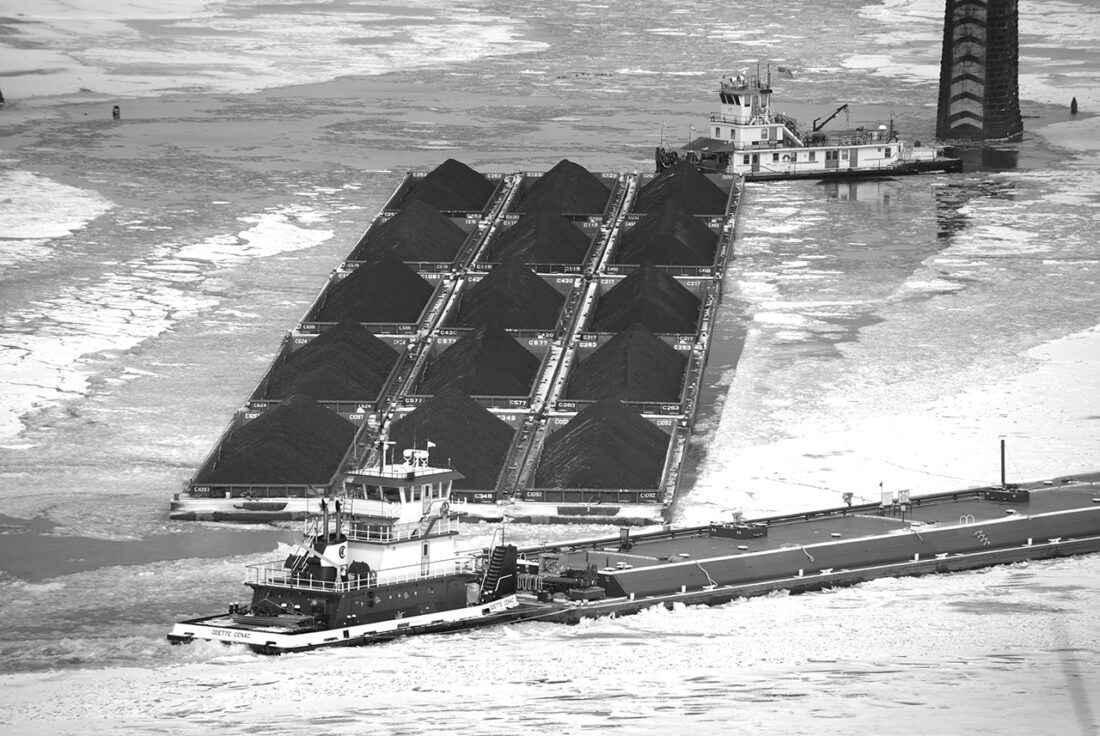
A pair of towboats work to free a string of coal barges from the ice of the Ohio River between Parkersburg and Belpre in 2018. (Photo provided)
With winter comes cold, and with cold comes ice.
Ice on our roadways adds danger to our daily commutes, it’s something that northern drivers learn to deal with, but it still causes havoc with our lives when it closes schools and cancels events.
Ice on the rivers though, is a different story.
In modern times, ice on our rivers is fairly rare, with it only happening after an extended period of cold, dry weather.
The Ohio River is deeper here than it once was. The series of dams along the river means that it always has enough water for barge traffic to pass. When the Belleville dam was finished in 1968 it raised the level of the river in Marietta and Parkersburg by several feet and eliminated periods of extremely low water. Deeper water takes longer to freeze, so the chance of it freezing is somewhat reduced.
It does, of course, happen.
For instance, the winter of ’77 was so cold, with an average January temperature of just 11.9 degrees, that the Ohio River froze so thick that the barges could not get through with the coal to burn at the power generation plants along the river.
Barges are normally able to break through the ice, but they do have their limits, and they found them that year. Schools closed that year to conserve energy.
Before the time of large dams and powerful barges, traffic on the rivers would simply halt when conditions were bad, frequently seeking refuge at confluences with tributaries such as the Muskingum River. Many early sternwheelers met their end after being caught by ice.
There are many historical photos of people out on frozen rivers enjoying the day. Going out on river ice is extremely dangerous. The number of drownings reported in the newspapers in the early 1900s is frankly shocking.
There are several historical accounts of the frozen rivers causing issues for residents.
A flood in 1813 put eight feet of water onto Front Street, but it was the 18 inches of ice slamming into buildings and fences that did the most damage.
One of the most fascinating frozen river stories I have heard is about Col. William Stacy.
Stacy was a remarkable man. He fought the British at Bunker Hill and he helped to establish a young Marietta. In 1789 he got word that a group of people trying to establish a settlement at Big Bottom on the Muskingum River above Stockport were about to be attacked by native Americans who had warned the people to stay away. He strapped on a pair of skates and went up the frozen river to warn his sons and others of the attack. No one took him seriously, and he skated back to Marietta.
His descendants still have the skates, although I don’t think they have been used on a frozen Muskingum for a very long time. Remember, without dams the river would have been very shallow in the middle of winter.
The Muskingum and Little Kanawha rivers have much less barge traffic than the Ohio River and are more likely to become frozen over. I have seen barges stuck in an icy Ohio, but this is rare. I took the photo with this column on an extremely cold day in 2018.
Even though it may look safe to walk on a frozen river. It is not. The thickness can vary greatly based on the unseen current below the ice. STAY OFF OF IT, you will be doing yourself and the first responders that would have to attempt to save you a huge favor.
Local Columns
MOV Climate Corner: Standard of Living – Questioned
Aldo Leopold, a man considered by many as the father of modern conservation wrote, “Like winds and sunsets, wild ...
Icy rivers should be enjoyed from a distance
Explosive Cyclogenesis and the 1950 Blizzard
Learn from questions
We are on our January Florida vacation for the last two weeks, with some work mixed in. Shale Crescent is taking ...
The rest of the story
My youngest brother Ron and I were visiting on a call just before Christmas. I am the oldest of six boys. My ...
“Hark the Herald Angels Sing, Glory to the newborn King”
By Mark Wilmoth Things don’t always go according to plan. Back in 1737, Charles Wesley wrote a Christmas carol ...