
The Way I See It: Fire has reshaped downtown Marietta
Trending
As Marietta grew, so did the risk of fire. By 1900 downtown Marietta was a dense collection of buildings that share walls with their neighbors. The arrangement was perfect for the shoppers that mainly used the sidewalks, not the roads, to go from merchant to merchant.
The problem with a densely packed community is when something goes wrong for one business; it quickly affects the neighboring stores.
Fire has been a major force in the reshaping of downtown.
Take a walk around Marietta and you will see evidence all over where our streetscapes were shaped by fire. Most of the gaps between buildings were created when fires destroyed structures.
Marietta buildings taken by fire fall into one of two categories. Those that burned so completely that nothing remains, and the space has since been reused, frequently as a parking lot -- and those where enough of the building remained that it could either be rebuilt or repurposed.
One of Marietta's largest fires happen when on April 27, 1916, fire destroyed the upper floors of the Bellevue Hotel. The building at Front and Greene streets was heavily damaged and was later repaired and reopened as the Lafayette Hotel.
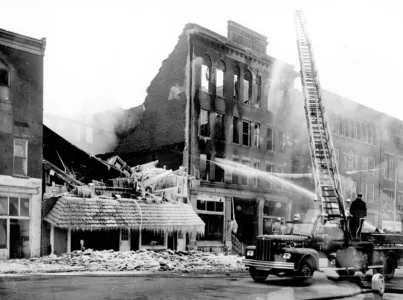
That part of town has been hard hit by fire. Fire has repeatedly reshaped the area. The Flamingo Supper Club fire at 108 Front St. in 1962, was one of several that changed or destroyed businesses there.
A block away at Front and Butler, you can see the scars of two different fires that heavily damaged the area. On the west side of the street there is a store front that was part of the 740 Social restaurant. It has no roof because the building burned on March 16, 1994. You can still see the burn marks on the wall. Across the street a building that had once been the St. Cloud Hotel burned on March 22, 2010, taking the two buildings next to it out with it. All because a thief was trying to cover his tracks. The Cook Shop was damaged but was able to later reopen.
The 200 block of Front Street has not been immune to fires. A line of storefronts was taken out by fire on Nov. 28, 2003. The facades were saved but the buildings behind them were replaced with modern structures. A short distance away, the beloved Brownies Bakery was destroyed July 10, 2005, much to the dismay of thousands of kids and former kids that would stop there for a cookie or a doughnut. It was rebuilt, but as an office, not a bakery.
Across the street near where the Armory parking lot is today once stood the Phoenix Mill. It burned on May 1, 1900, and then again on Oct. 31, 1912, and Dec. 12, 1912, before eventually calling it quits. Whatever remained of it would have been washed away by the floods of March 1913.
Further down the street, the First Congregational Church with its distinctive two towers has burned. The current brick version was built in 1906 to replace a wood version that burned in 1905.
The Elks Club once stood next to the Cawley and Peoples funeral home. The fire that destroyed it on Feb. 1, 2001, was so hot it melted the siding on the nearby funeral home. Today condominiums occupy the space.
Second Street was the location of a fire that killed firefighter Bob Berry on Jan. 19, 1967. The location was never rebuilt and is now a parking lot next to what was for a long time, the Pastime complex.
Down the street, a massive fire destroyed the Union Hardware Store on July 7, 1932. The area was later rebuilt and is now home to the Pizza Place. You can see a photo of that fire on page 2 of today's newspaper.
One of the most devasting fires downtown was on Nov. 11, 1935, when the Marietta auditorium burned. The building housed city offices, including the police department, city jail, and the fire department. A prisoner, Clyde Hilderbrand, set fire to the building that was destroyed. The City Hall at Third and Putnam streets was the replacement for the burned building. The absence, or inclusion of the large tower of the building, is a handy aid to place a date on old photos of Marietta.
Even the bridge to Williamstown has not been immune to fire. It was damaged on Sept. 10, 1939, by a fire on its wood decking.
The Harmar House fire on Jan. 9, 1970, killed more than 20 residents. The fire led to nationwide changes to prevent fires in nursing homes. The care facility still operates today as Waterview Point.
Marietta, a city known for the devastating floods that have poured through town, has been shaped more by the fires that have happened in the community than the waters that have inundated it.
Art Smith is online manager of The Marietta Times and Parkersburg News and Sentinel, he can be reached at asmith@MariettaTimes.com.