
Early Marietta: Henry the Dreamer and the Steamboat WASHINGTON
Trending
Marietta is considered the pioneer city. The Steamboat WASHINGTON and her legendary captain Henry M. Shreve were pioneers as well. Rivermuseum.org: “Henry M. Shreve remains a giant among America's rivermen. More than any other individual, he changed inland river travel in the first half of the nineteenth century.” Shreve grew up on the Youghiogheny River, fascinated by the activity on the river. He heard exploits of river boatmen. Henry’s older brother John made a trip down the Mississippi. Henry was hooked.
At age 22 in 1807, he built a 35 ft keelboat at Brownsville PA, hired a dozen boatmen, and set off for St. Louis. He stopped at Marietta for supplies and was peppered with the usual questions asked of river arrivals. “What’s the latest news? "What do people from the East think of Aaron Burr's being acquitted of treason? ” Mariettans were familiar with Burr’s activity. Henry was totally focused on the river; he sidestepped the queries.
Henry Shreve was astute, learning with every turn in the river, every conversation with traders. He soon realized that money could made by traveling UP the rivers. That's what he did. Unpowered boats relied on oars, poling, or sails to move upriver. It was slow and exhausting for crews, though they revived at night with whiskey, card games, and fist fights. His trips from Pittsburgh to St. Louis and back made him tons of money buying furs and selling them back east. Once it was literally tons, when he befriended Indians in Illinois who sold him tons of lead ore. Lead was in high demand for munitions. He made $11,000 ($250,000 today) on that one trip.
Henry’s barge business expanded to New Orleans with arduous but profitable trips on the untamed Mississippi River. There had to be a better, faster way to move goods on the rivers, he thought. He’d observed that early steamboats like NEW ORLEANS, VESUVIUS and COMET failed because they lacked power, durability, or had a too-deep draft for shallow riverbeds. Over time he had completely designed a new type steamboat – in his head. That boat would become the WASHINGTON.
Shreve's first steamboat experience was on the new boat ENTERPRISE. The War of 1812 was on. ENTERPRISE left December 1, 1814 from Pittsburgh with supplies for General Andrew Jackson's army at New Orleans. It was exhilarating to feel the power and speed of this new form of transportation. But he felt a double whammy of anxiety - his inexperience and the urgency of getting supplies to New Orleans. The steamboat's arrival on December 14 at New Orleans boosted morale. Each day until the January 8 battle, ENTERPRISE was moving supplies and men for General Jackson.
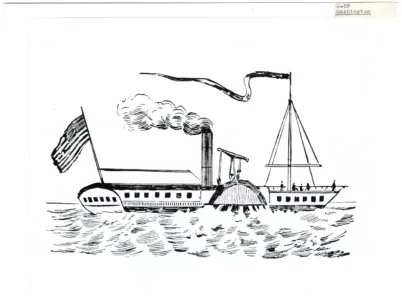
Henry Shreve returned to Brownsville, but boat builders were dismissive of his design suggestions. No problem. He would build his own boat. The new boat, WASHINGTON, launched in 1816. Using Shreve's revolutionary design concepts - some ridiculed by boat "experts" – the finished WASHINGTON had more power, shallower draft, drastically lighter weight, a separate deck for passengers, and greater fuel efficiency than any other steamboat. This pioneering vessel set the standard for future steamboats. The WASHINGTON visited Marietta in June, 1816. Find out what happened in the next "Early Marietta" edition.
Henry Shreve was indeed a pioneering genius with numerous "firsts," in addition to his revolutionary boat. His WASHINGTON completed Mississippi travel in record time. He boldly defeated the monopoly of the Fulton-Livingston Company which prevented competing steamboats such as Shreve's from operating in the Louisiana Territory, despite jail time and numerous legal challenges. Shreve later designed a device for removing river "snags" (tree stumps and other impediments), a major source of damage and sinking. His love and passion for all things river never left him.