
The Way I See It: MC turned to river to help house surge of post WWII students
Trending
In 1946 colleges had a problem. Too many students.
The recent end of World War II meant that the millions of Americans who served their nation were ready to get on with their lives, and for many of them, that meant going back to or starting college. The GI Bill provided many of them a chance at an education.
Colleges around the country grappled with how to handle this sudden influx of students. More professors would have to be hired, and they would have to find a place for everyone to live.
In the fall of 1945 Marietta College Dean William Bay Irvine said "We have reached our capacity. From now on every new student becomes a problem." The college had to get creative, and it had to do so quickly. Enrollment was set to double in just one year.
Some students found housing in private homes in Marietta. Others took up residence in the 19 house trailers that had previously been used near a Dayton factory producing goods for the war.
Others would be housed in one of the 13 military huts that were constructed all over campus.
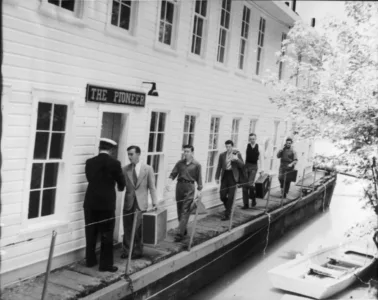
For the most unique housing, the college turned to the United States Coast Guard. They purchased a two-deck floating dormitory and had it towed from Point Pleasant to Marietta. The monument to westward expansion in Muskingum Park provided the perfect spot to tie up the 110-foot temporary home for 30 men.
The name was changed to "The Pioneer," the wide-open upper deck was portioned off into 15 two-man cabins; with the bottom deck housing restrooms, a mess hall and kitchen.
On June 16, 1946, the first residents moved in when a group of recently discharged veterans arrived to begin their college education.
A dorm in the middle of the river presented some unique challenges for the residents. "The Pioneer" had a tendency to rock a little bit when a boat went past. Although it was pretty comfortable when the students moved in during the summer, things got a bit rough when it got colder.
The gang plank between the monument and the boat had a tendency to freeze and become slippery.
The lines that brought heat and water onto the boat also froze when it got cold. Small gas stoves on the boat did little to heat the boat, and it always felt damp on the vessel.
On Feb. 10, 1947, the 17 students that were still on the Pioneer packed up and moved onto land when they occupied a former Army barrack near Fifth and Butler streets.
The college had solved the problem of finding places for people to live without having them floating on a barge in the middle of the river.
The college, which had paid $2,500 for The Pioneer, sold it to the Army-Navy Club of Cincinnati for $5,000. It was towed there and converted into a restaurant. It burned a few years later.
Art Smith is online manager of The Marietta Times and The Parkersburg News and Sentinel. He can be reached at asmith@mariettatimes.com