
Early Marietta: The Marietta and Cincinnati Railroad: Lofty vision meets harsh reality
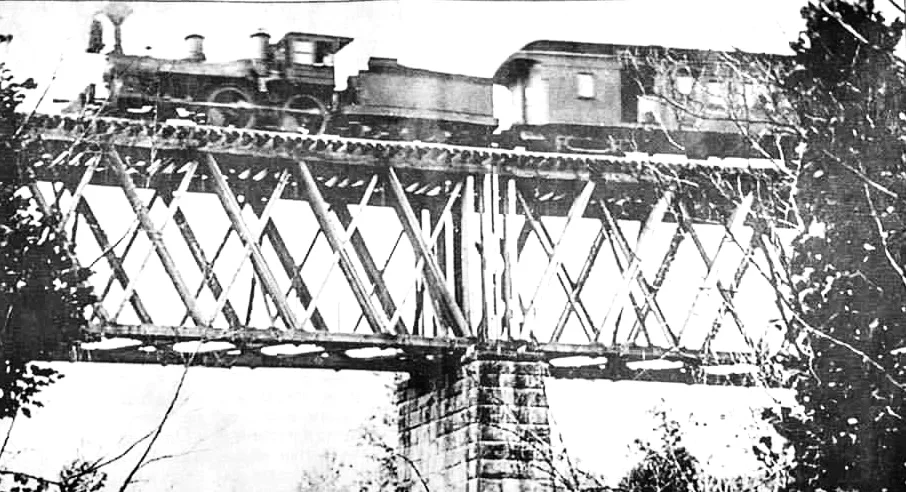
Train crossing 80 ft. Dunbar trestle, located between Vincent and Cutler, in the late 1800s. (Photo provided)
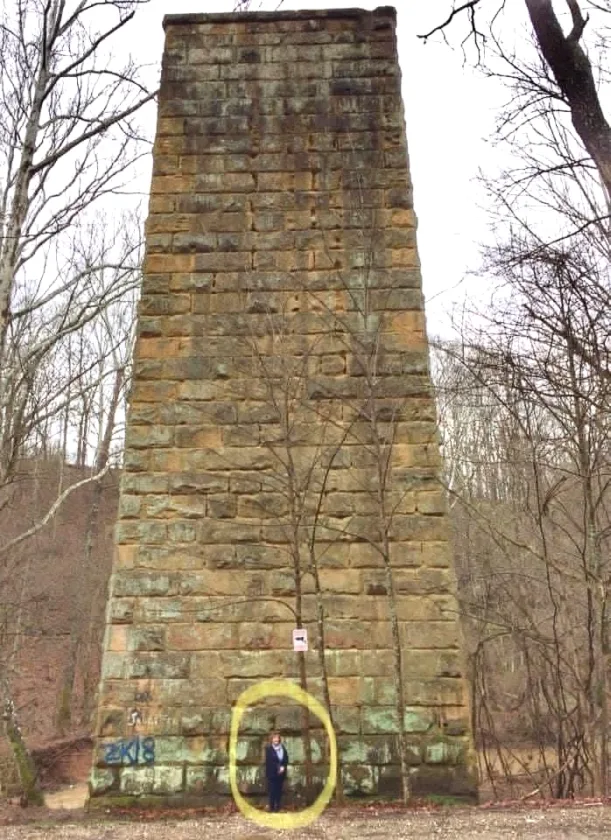
One of the remaining piers from Dunbar trestle, dwarfing person standing at the bottom. (Photo provided)
Train crossing 80 ft. Dunbar trestle, located between Vincent and Cutler, in the late 1800s. (Photo provided)
One of the remaining piers from Dunbar trestle, dwarfing person standing at the bottom. (Photo provided)
Trending
William P. Cutler obtained a charter for the Belpre and Cincinnati Railroad in 1847. He envisioned it as the “Great Central Route of the Ohio Valley,” opening Ohio products to markets east and west. Soon Cutler was President, fund raiser, and leading advocate. Many communities pledged money, chasing the promised economic benefit and haggling for a route beneficial to them. Washington County and Marietta contributed $350,000 in exchange for the name change to “Marietta and Cincinnati.”
The Pennsylvania Railroad invested $750,000, seeking access to Ohio Valley markets. The City of Wheeling gave $250,000 for an M&C line up the Ohio Valley to Wheeling. Money talked. Cutler noted, “this tall talk about dollars has a charm not easily resisted.” By 1953 the entire line from Wheeling to Cincinnati was under contract; thousands were employed in construction.
The lofty vision would soon collide with harsh economic reality. Costs exceeded plan. The hilly Southern Ohio terrain required many tunnels, trestles, and culverts, expensive to build and maintain. In 1854 an economic panic dried up financing sources. Additional funding was sought. The Marietta to Wheeling line was shut down. Even over-extended original investors pledged more to keep the project alive. Noah Wilson, V.P. of the M&C, went to Europe to sell bonds. A polish financier, Count Zaleski, bought $1,000,000 of bonds in exchange for some land and having the town of Zaleski, Ohio named after him. The M&C found the money needed.
At long last, the first train ran between Cincinnati and Marietta in 1857. However, the M&C continued to be plagued by financial stress, depressed freight rates, and weather disasters. Workers went unpaid and walked off the job. Cutler: "It is awful to be haunted with obligations one cannot pay." Creditors repossessed several locomotives. Heavy rains collapsed track sections and brought down a trestle, killing 5 people. A frustrated Cutler observed: “Everybody…curses the (M&C), up grade, down grade, around the curves, across the trestles, and through the tunnels.” The M&C entered bankruptcy in 1858 but emerged stronger in 1860.
Eventually, a shorter, easier to maintain line was built in 1874 from Belpre to Athens. In 1876 the original problematic M&C line from Marietta to Athens was abandoned. A new line from Marietta to Belpre, the Union Railroad, allowed for direct connection to Cincinnati and the B&O line running east. Over time, the Baltimore and Ohio (B&O) railroad assumed control of the M&C.
Historian John Pixton, Jr. noted, "As with many early railroads, an incurable optimism," mixed with inexperience and unforeseen competition, contributed to the M&C struggles. Investors poured millions into M&C, mostly money down the drain, in pursuit of Cutler's "Great Central Route of the Ohio Valley" dream. Though the M&C itself was a financial failure, the optimism about the line's potential was vindicated. The B&O Parkersburg to Cincinnati rail line, successor to the M&C, was active for over a hundred years until 1985. William P. Cutler, the stoic and dogged M&C proponent, persisted in completing the road in the face of daunting obstacles. He endlessly recruited investors, enlisted legislative help, faced down unpaid workers and naysayers, and NEVER GAVE UP.
Washington County features of the old M&C included the huge 80 ft tall Dunbar Trestle (piers still standing) and the now abandoned 1,300 ft Vanderwarker tunnel, near the Tunnel community. The tunnel engineering was unique, redirecting water from a stream in a wooden viaduct running above the tracks. The King’s Hollow Tunnel and the iconic Moonville Tunnel are visible in Vinton County, now part of a rail trail.