
Traveler impressions of early Marietta
Trending
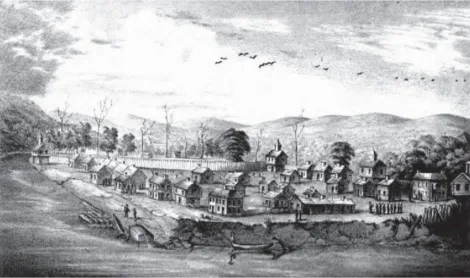
Visualize what Marietta looked like in the 1790s and early 1800s. Actually, visualizing is all you can do because period images are rare and incomplete. But we have the fascinating observations of several travelers.
JOURNAL OF A TOUR IN UNSETTLED PARTS OF NORTH AMERICA, FRANCIS BAILY. He arrived at Marietta from Pittsburgh on the Ohio River on February 21, 1797. — He mistakenly called Marietta “Muskingham." –He labeled Long Reach, the 16 mile straight stretch of the river, “the most beautiful place I ever saw in my life.” -The town had “about one hundred houses agreeably situated on the eastern side of the Muskingham River.” -He saw an “old fort" (perhaps Campus Martius, then being dismantled), and nearby graves (Hopewell earthworks, probably) similar to those at Grave Creek.” –Below Marietta that night on the river, he witnessed strange moving lights in the dark in the midst of lightning and thunder. He first thought it was “ignis fatuus,” or St. Elmo’s fire. Closer observation revealed Indians dancing around a campfire.
THADDEUS HARRIS’ JOURNAL OF A TOUR (1803). April of 1803: –He is awed by the beauty of nature: ...”dark forests…blooming shrubs…lively carols of the birds…” and vast numbers of wild animals “afforded us constant amusement.” –Below Willow Island: “fine cultivated plains and rising settlements (that) charm the eye…” –“Marietta is …”rapidly increasing in population, wealth, and elegance.”–Several ocean-going vessels built upriver passed by; a brig built at Marietta set sail. –a hollow sycamore tree 60 feet around could hold "eighteen to twenty persons.” - "Judge (Paul) Fearing is trying to grow “delicious island grapes.”
Harris noted stark differences between Ohio and Virginia settlers. Ohioans he characterized as “intelligent, industrious, and thriving” with “neat buildings” on well laid out grounds. Virginians along the river were “ignorant, lazy, and poor” living in “miserable cabins.” Not sure how he formed these opinions; Ohio had its share of rough inhabitants, too.
TRAVELS ON AN INLAND VOYAGE by CHRISTIAN SCHULTZ JR. recorded observations in 1807 in letters to a friend. -Marietta's earthworks: “…walls, ramparts and mounds of earth of astonishing magnitude and extent…” He correctly noted the “diversity of opinion” on their purpose – whether built as elaborate fortifications or as “towns” with “temples, gardens, and sepulchers of their dead.”--He observed “about one hundred eighty houses…several may be considered not only gentile and but even elegant.”–Marietta is a New England in miniature; her inhabitants are sober, honest, religious and industrious, while dissipation and irrational amusements are not known…” –The Muskingum River…"is navigable for keel boats for 140 miles." –locals raise “small crops of coarse cotton.” –I have seen a few cat fish, buffaioe fish, sun fish, perch, chub, suckers and herrings… –No town west of the mountains “can rival Marietta in the number of her enterprising and well-informed citizens.”–
THE NAVIGATOR, 1807 edition, written by Zadok Cramer, was a guide for river travelers in the eastern U.S. –“(Marietta's) inhabitants are principally New Englanders, whose industry is as proverbial as their system of life is economical, moral and religious.” –A bank capitalized at $100,000 was started that summer. –He mentions flooding risk and states that “the inhabitants, it is presumed, will (seek) higher ground for their future buildings.” That advice has not been followed.
Not all comments were positive. One opinion from late 1700s: “I find Marietta a poor muddy hole--the mud here is more disagreeable than the snow in Massachusetts.” Another mentioned log huts, tall tree stumps, and muddy foot paths. Such was life on the frontier.