
Trending
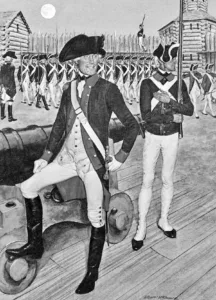
Visualize the soldiers guarding the Tomb of the Unknown Soldier at Arlington National Cemetery. Their meticulous uniforms and precision moves are impressive, symbolizing the nation’s commitment to “never forget” the fallen. There’s a connection to Marietta. The Third Infantry Regiment (nickname: “The Old Guard”) that performs those duties is the longest serving permanent U. S. Army unit. It traces its origin to the First American Regiment, created in 1784 to guard the nation's western frontier. Its soldiers were stationed at Fort Harmar, named for the first commander Col. Josiah Harmar.
The fort was erected by soldiers on Nov. 5, 1785, on the west bank of the Muskingum River at the Ohio River. It had a pentagonal shape and occupied about 3/4 acre. Land in eastern Ohio was being surveyed for future settlement. The mission was to protect surveyors and legal settlers from Indian attacks and remove illegal settlers (“squatters”).
Sgt. Joseph Buell arrived at the fort in May 1786. Quotes are from his journal. Life at the fort was rough. The garrison was inadequately supplied; they were often on half rations. Some soldiers lacked proper footwear and clothing. One group returning from guarding surveyors " … had a tedious cold time of it. Some were without shoes and their feet badly frozen." Sometimes only the daily liquor ration (about 4 oz of rum or whiskey) kept them going – keeping spirits up by pouring spirits down, you could say.
Discipline was strict. Even petty offenses warranted confinement, whippings, or worse. "Brady was whipped 100 lashes for taking a coat out his serg'ts room." Deserters could be shot without a trial. Major John Wyllys did just that, executing three deserters at Fort McIntosh. Disease stalked everyone on the frontier. Engeham died in May; "the first due to sickness." A month later Bamerd died. When a death occurred, soldiers accompanied the coffin led by an honor guard with fife and drums. Music was somber at the burial, but returning they played a "jolly tune." Some of the dead were interred in today's Harmar neighborhood.
Accompanying surveyors was rough and dangerous duty. In June of 1789, several soldiers accompanied crew leaders John Mathews and James Backus on a surveying trip. Backus's journal reported "bad hills," heavy rain, and a balky compass. Mathews' group noticed signs of Indians: Scouts observed horse and moccasin tracks. Tensions rose; sentries were posted at night. One morning well past sunrise, the armed crew members relaxed around a campfire. Suddenly deafening shots rang out. Indians! All soldiers except one died instantly. Survivors including Mathews fled and were eventually rescued.
Indians were a constant concern. Some Indians seemed friendly; they camped near the fort and traded with soldiers. One night, they demonstrated their war dances INSIDE the fort. Troops were amused but always vigilant. A treaty was negotiated with several tribes at Fort Harmar in January 1789. It had little effect; hostilities continued. Once Sgt. Buell sent his cook to Kerr's Island to get milk. He did not return. Buell feared the worst. A search party found only his hat; he'd been killed and scalped.
Evicting squatters living in the Ohio Country was difficult, often dangerous, usually futile. There were thousands of illegal settlers, many openly defiant of federal authority. Most people obeyed the troops and left, but they returned within weeks. There were too many squatters and not enough soldiers.
Many men who served at Fort Harmar went on to fight, and die, in early 1790s Indian battles. On Veterans Day, we honor those who served here and beyond, enduring hardships and danger, to prepare the way for settlement of Marietta, the future state of Ohio, and an expanding nation.