
Students learning how to respond to overdose
Virtual reality, immersive learning train for crises
Trending
Imagine walking into a classroom, dorm room or office and realizing a person there has overdosed.
Maybe you notice the needle in their arm, perhaps you call 911, maybe you clear their airway or try to administer CPR. Someone might pull out their phone and start filming, or they just freeze--but just maybe, you act-- you find the available naloxone kit to get them breathing again.
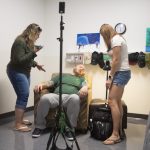
All of those reactions are demonstrated in a virtual reality scenario Ohio University educators are developing as a part of the institution’s Immersive Media Initiative--a scenario they plan to make accessible on any cell phone, in any location.
“In this scenario, they’re in a dorm room and start looking for a Narcan (a brand name of naloxone) kit,” explained Dr. Shirleena Buchman, an assistant professor with OU’s College of Health Sciences and Professions. “But having this in virtual reality with a 360-degree video, you can look down, over your shoulder, see the whole room and feel immersed in the moment.”
Naloxone, also known in some forms as Narcan or Evzio, is a medication that can reverse an overdose caused by an opioid drug such as heroin or prescription pain medications. When administered during an overdose, Naloxone blocks the effects of opioids on the brain and quickly restores breathing.
It’s available over the counter at most pharmacies, plus county health departments and many first responders carry the medication.
But the immersive video built by OU is to be used in training not only health science students at the college-- it’s intended for any audience, to encourage a conversation and preparation of what to do in a crisis.
“We’re working with (OU’s) Scripps College so that it can be accessible to any viewer, especially as our communities continue working towards responding to the drug epidemic that’s hit our communities so hard,” said Buchman.
And this heroin overdose immersive scenario has begged the question -- are educators and educational institutions prepared for an overdose situation on campus?
“Some colleges are calling for Narcan kits to be more readily available in dorms,” noted Buchman. “Here in Athens, our OU police department and our county health department have them.”
Marietta College Police Chief Jim Weaver said Thursday that the college doesn’t keep the kits on hand, but relies on the mutual response of Marietta’s fire department and emergency squad to medical calls.
“We thankfully have not had that situation occur on or near our campus yet,” said Weaver. “But we’re not opposed to carrying it. We have had discussions about it. My only concern is Narcan has a shelf life and I don’t know what the ramifications would be if we used a kit that’s expired or that’s been back and forth in different heat environments in our cruisers.”
Weaver said most medical calls his department responds to on campus are also immediately teamed with the city fire department.
“And they typically take over in a medical scenario anyways, so we leave that to them,” he said.
Likewise in Marietta City Schools, Superintendent Will Hampton said the discussion has occurred, but the schools’ nurse offices and staff are not currently stocked with the antidote like they are with AEDs, first aid kits and EpiPens.
“We have talked about it but have not acted on that,” he said Friday. “It’s not come up recently in our safety committee meetings.”
He said the school system had not to date had to assist with an overdose on school grounds, and didn’t believe other surrounding school systems stock the antidote either.
Washington State Community College representatives did not return calls for comment on whether they keep the medication on campus.
But more than just a reaction to the opioid epidemic which swept much of the nation, OU Professor Eric Williams said the potential of supplemental training in virtual and augmented reality, like this overdose scenario, allows academia to be at the forefront of crisis preparation.
“This is one of about six different projects we’re currently working on with AR and VR,” he explained, noting the applicability to teaching situational awareness in a mental health crisis, in different emergency room perspectives and even in clinical preparation.
“We’ve gamified it so they can practice at home with their cell phone and Google cardboard, or on an iPad,” he explained. “Then when you walk into your practicum it’s actually the same rooms you’ve already been virtually practicing in, increasing your familiarity with the environment.”
He said the scenario is repeatable and consistent and can be used to quiz students over and over again on what they notice in quick time spans.
“It’s training those observational skills and encourages the discussion about bystanders and about what else you’re noticing in the room,” added Buchman. “In the overdose scenario there’s a kid behind you bouncing a ball, there’s a hesitation to call 911 because they don’t want to get the kid in trouble--all of that can be a very real part of a real overdose.”
Then in addition to partnering with the university’s nursing program, Wiliams said the OU project has partnered with Northern Arizona University and San Francisco General Hospital to utilize augmented and virtual reality in training physical therapy and emergent care.
“The technology for training is moving so quickly, but academia has a reputation for reaction and response that’s behind the times,” he explained. “Here we’re forcing forward thinking and pushing the boundary rather than just reacting after the fact.”
At a glance:
• Ohio University’s Game Research and Immersive Design (GRID) Lab has partnered with the school’s nursing and physical therapy programs to create immersive learning scenarios in 360 virtual reality.
• The nursing program has produced a heroin overdose immersive situation which will soon be available on the College of Health Sciences and Professions’ YouTube page for consumption on any smartphone or tablet.
• The school has also partnered with Northern Arizona University and San Francisco General Hospital to create similar training modules in 360 virtual reality.
Source: Ohio University.