
Hooked on heroin: Life as an addict

Trending
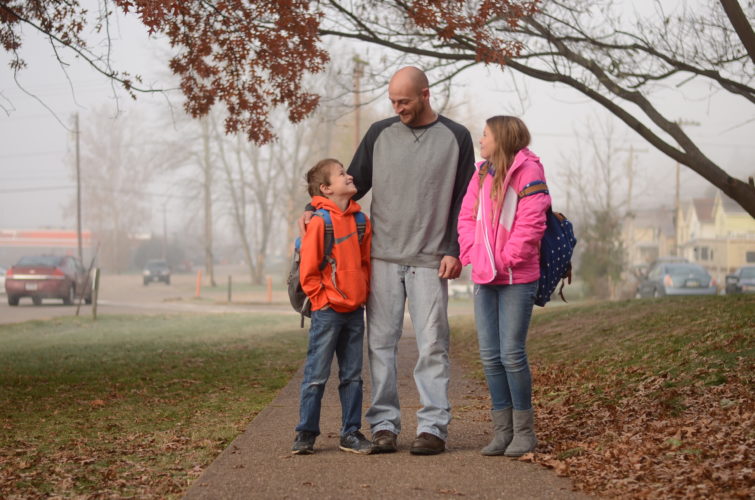
Cory Meeks, 31, of Marietta, walks his two children, Brooke, 11, and Ethan, 8, to Phillips Elementary School recently while sharing smiles and laughs.
HANNAH KITTLE The
Marietta Times
As Cory Meeks, 31, of Marietta, tried heroin for the first time, a warm rush flooded through his body and a comforting heat resided, binding him to his new love affair with the instantly addictive drug.
"I was addicted to heroin for 10 years," he said, noting he was using a variety of other drugs as well. "The feeling I got from that was absolutely incredible; I fell in love with it."
Meeks, a recovering addict, battled with drug addiction since he was 12 years old when his father offered him a joint of marijuana. Even though he is clean now, he thinks daily of the struggle and hardship it took to get there and the sacrifices he made along the way.
Often times, heroin is a faceless killer, turning people into statistics. Many don't understand how the addictive drug grips the lives of real people who spiral while reaching for help, but are unable to secure their footing.
With the increasing number of drug abusers comes a growing community of recovering addicts who have the desire to halt the epidemic and help those who have also suffered from heroin's hold.
Three local people who struggled with heroin addiction recall their stories and continue to hope for change.
Cory Meeks
"I've been up and down the East Coast buying and trafficking drugs," Meeks said. "I have finally reached a point in my life where I just want something else."
Meeks recalled his first introduction to hard drugs at an early age, noting his addiction consumed him and took away 20 years of his life.
"I tried my first line of cocaine at 12-and-a-half, 13-years-old," he said. "I got that rush and absolutely enjoyed that rush; I quit high school my sophomore year and left home and got a small place˘.I was actually selling cocaine to support my habit."
Nearly eight years later, Meeks found himself in a four wheeler accident and prescribed with pain medication that eventually ran out; heroin was his saving grace from the pain of recovery, thus beginning his affair with a new rush.
"When I was 20-years-old, I ruptured a vertebra in my neck in a four wheeler accident and was prescribed Vicodin for about a year˘.I turned to the street for relief," he said. "I had my first child and they took me off of pain pills, so I turned to the streets and began using IV heroin."
Meeks said his addiction truly spiraled from there, causing him to lose his family and everything he cared about along the way.
"I robbed, I lied, I manipulated…I did whatever I could to be high," said Meeks, noting he served prison time in 2009 for drug trafficking and was released in 2010. "I was able to stay clean for a couple of weeks, but I went right back to the old circle and began using heroin again; I pushed family away because of my addiction and they turned away from me."
It wasn't until 2015 when Meeks was prescribed Xanax that his drug of choice changed immediately. He was easily able to get a prescription for however many drugs he wanted and was receiving 120 Xanax a month.
"I was constantly in a blackout because I was abusing them," he recalled. "I was on my way to death."
Meeks said the high from Xanax alleviated all pain and concern for the time being.
"The high was a warm, tingly feeling," he explained. "It just took away all the pain from my mistakes and addiction and I didn't have to live with anything for the moment."
During a house visit, his probation officer found Meeks blacked out after already consuming 30 Xanax in one sitting.
"He got me up, put my shoes on me and put me in jail," noted Meeks. "He left me in jail for 21 days to clean me out; had I not encountered that situation, I would be dead."
He noted withdrawal is the worst thing one could ever experience.
"It's horrible; all you are focused on is getting better and that, of course, comes in the form of getting high," he said. "The first thing I withdrew from was heroin; it's a lot of anxiety, body pain, muscle cramps, racing thoughts…it's pure hell."
Meeks said he overdosed one time and almost overdosed another. He noted the withdrawals after overdosing were almost too much to bear.
Now, Meeks hopes to help others and bring in more support groups to combat the increase in heroin addiction.
"I want to help, I want to be a part of it and I want to see people come together," Meeks explained, noting there aren't a lot of services in Marietta for those struggling with drug addiction. "There are several AA meetings, but not a lot of NA meetings and sometimes we're not appreciated in their groups; I firmly believe we can receive help in coming together to help each other…isn't that what it's all about?"
Meeks said because he entered a treatment program and became clean, he can now enjoy his life with a family who now trusts him again.
"It's a great feeling to be out from under the thumb of addiction; my daughter doesn't look at me and say, 'Daddy, you've got them funny eyes,'" he said. "I remember doing things with them, today, when a year ago I didn't know one day to the next if I was going to be so smashed to the point I wasn't going to be able to do anything with them.I lived that life for so long, I didn't realize until a later age that, that wasn't the life for me."
He advised others who are thinking about trying heroin just once to stay clear of the drug.
"Please don't, it's not worth it; some people can use one time and lay it down, but other people can use one time and be dragged in," he said. "It's different for each individual, but it could easily cost you the rest of your life, or your actual life for that matter."
Linda Murphy
For Linda Murphy, 50, of Marietta, overdosing happened as her 11-year-old daughter stood watching in the kitchen, clutching the phone as she dialed 911 because her mother lay unmoving on the floor.
"That actually happened a couple of times; when you overdose, it's because you have put so much drug in you that your body shuts down," said Murphy. "You don't realize you've overdosed, but when you are coming out of it, when they get you to the ER and they are trying to pump your stomach, that is something you can remember and feel."
Murphy said the process in recovering from an overdose is a painful and uncomfortable process.
"It is a horrible ordeal to go through because they have to take a tube about an inch around and flow it down your throat to get all of the stuff to come out of your stomach and they put charcoal down there and you are throwing up all there is in your stomach," she said. "It's all over you and they don't try to clean you up, either."
Murphy noted the next day isn't much better and described withdrawal to be the worst thing an addict faces.
"That's why people don't stop (doing drugs) and just give it up because the withdrawal is so, so horrible," she said. "I mean, you feel like you would rather die than go through another day of withdrawal."
When she was 13-years-old, she said she had to have back surgery and spent two months in the hospital.
"I had to learn to walk all over again; I was in a lot of pain," said Murphy. "Afterward, I was able to get pain medication -- just about any kind I wanted."
Tracing back her addiction trail to her adolescence, Murphy recalled her first drug of choice being painkillers.
"They had me on very high painkillers and it's been a struggle with pain medication all my life from that point," she said. "The surgery really made it easy for me to get the medication I fell in love with and it was so easy for me."
Murphy added doctors would take a look at her x-ray and as soon as they saw all the rods and wires all the way down her back, they would provide prescriptions for all kinds of pain medications.
"I could tell them anything and they would write it," noted Murphy. "Now I'm 50-years-old and I've been in and out of so many treatment centers."
The pills morphed into heroin at times when the medication's availability dwindled. Murphy had surrounded herself around a community of addicts and she and her husband fueled their addiction together, she said, recalling their young, abusive relationship.
"It was 27 years of horrible drug addiction and abuse and I was in and out of recovery; we had two kids 10 years apart and we put them through hell," she said. "We did (heroin) because it was available when the pills weren't around; when I couldn't get to the doctor, the heroin was there and we would make runs to Detroit to bring it back here and sell it to fund our drug use."
Murphy faced significant loss from the addiction and felt immensely grateful to have survived that time of her life when many of her friends and husband did not.
"I have a wedding picture of me and my husband," she said. "Every single male in that picture is dead from drug abuse and almost all the women."
Murphy remembers the rush of heroin the first time she tried it, noting a person could get hooked instantly with just one hit, especially for those who already enjoy the effect of pain pills.
"You get a hot rush feeling all over your body; you get really, really warm and you kind of feel like everything is good in the world, everything is right," she explained. "I don't know why you feel that way, but it just kind of brings that feeling to your mind."
While the first time may result in an uneasy stomach, Murphy said the heroin high drew addicts back to the subduing side effects.
"Usually, with people who are trying it for the first time, they will get physically sick to their stomachs," said Murphy. "But after that, they are just in such a high they kind of just melt back into the seat and just fall asleep a little bit."
After her husband died from drug abuse, Murphy chose to join the suboxone program at L&P Services after her counselor suggested it might help.
"I had never heard of it before, so I thought, why not?" she said. "I had always gone back to using, but though this suboxone program, I have not even wanted and haven't even thought of wanting to pick up a pain pill for two and a half years; it's been a huge blessing and miracle for me."
Now, Murphy spends time with her two grandchildren and is building back her family's trust again little by little.
"I didn't think there was anything out there that was going to help me feel normal or be able to keep me from that kind of life," she said. "It's been hard to get my children to believe and trust in me that I'm not using anymore because I've tried this so many times; needless to say, this suboxone program has been a life-saver for me."
Murphy works to help others who are recovering from addiction and hopes her long journey will have a positive impact on others.
"God was keeping me from so many things and I want to try to pay back some of the health that I have been given and the blessings I have been given and try to fulfill what I believe I've been kept here to do, and that is to help other people in recovery," she said. "My husband passed away from his addiction and we were both doing the same amounts, but I survived; I can see all the wonderful blessings God has given to me."
Isaac Work
Driving past the corner store in Beverly, flashes of memory of slipping toward the cold bathroom tile, fading into a flat-line come back to Isaac Work, 23, of Marietta.
"I don't really remember much, but I do remember going into the bathroom at the corner store and attempting to throw up the pills I'd taken," said Work. "I remember pulling myself up to the mirror, looking at how pale I was and saying to myself, 'you're dead.'"
Work recalled driving through Beverly and becoming angry, feeling the urge to commit suicide.
"I lay down on the floor and went to sleep because I didn't want to feel anything," he explained. "When I woke up, they were shoving a breathing tube down my throat and I was restrained to the bed; my throat and chest hurt really bad, but I was so out of it and my drug levels were so high that it took the whole 21 days to recover and I still wasn't in the right state of mind because I was so screwed up from all the drugs"
Thankfully, Works said medics were able to bring him back from his unresponsive state, giving him another chance at life.
"They took me to the hospital unresponsive," he said. "I purposefully took a bunch of psych meds to kill myself because I was tired of living the way I was; I was on life support for two-and-a-half days."
Work said his addiction began with pills when he was 13-years-old after joining up with older addicts who showed him what the high felt like.
"I probably did heroin from 14- to 15-years-old because I was sick from the pills; I snorted it at first and eventually at 16, I shot up for the first time," said Work. "It just made everything better…all my problems just seemed to go away and it made everything look better, feel better, everything was just better."
Comforting and inviting, heroin sent a wave of warmth throughout his body, hooking him from the first moment he tried it.
"My body felt slow -- you just lose grip of reality and you are inside yourself and in your own world; it feels amazing," he said. "I fell in love right from the get-go."
Eventually, Work started selling drugs at school to support his habit and would have other adolescents getting drugs for him to sell.
"That was the only way I saw fit to support my habit because I didn't have enough money," he said. "I moved in with a couple of dealers and my friend I was living with ended up going to prison for bank robbery, so I started hopping around a lot."
He said he was able to secure a couple jobs here and there, but nothing seemed to last and he turned to methamphetamine to get off heroin and opioids for a little while. However, he ended up back on heroin and methamphetamine at the same time.
After his best friend committed suicide, Work moved to Marietta and found himself homeless.
"I slept in my car in the Food 4 Less and IGA parking lots," he said. "I ended up getting arrested for pointing a gun at someone, went to jail and got out and then I went on the run from probation to keep using drugs because I couldn't stop; I ended up getting two new charges in Zanesville for possession of drug paraphernalia."
Work noted his long road to recovery with some stumbling along the way began then, after he was arrested about a year ago.
"As a part of my bond agreement, I went to rehab…that was the first time I had even really been sober since I was 13-years-old," he said. "After I got out, though, I was good for a minute, but I got around old friends again and I started using."
It wasn't until he failed his probation drug test that he found the will to commit to turning his life around with the help of rehabilitation.
"About 45 days into my first treatment, I had never seen that many people who wanted to get clean; I was really big on my reputation and how I'd been living my life…I didn't want to change because I had this image for myself," said Work. "Once I saw everyone else wanting to change, it allowed me to connect to my real feelings and deep down I knew I wanted to change; that was when I started craving it less and I was actually starting to feel good."
Work said his struggle with addiction had consequences that reached beyond himself.
"Before I got arrested a second time, I was at Burger King, I was really messed up and I was yelling at my girlfriend at the time; the manager called the cops on us," he said. "They ran our names and she had a prior trafficking charge and they searched the car; she swallowed the heroin to keep me from getting caught, but she was three months pregnant with my kid and had a miscarriage.
"I had a lot of guilt, so it took a lot of work and I had to just accept that it happened…I'm working to get past it."
Work grew distant from his family and would only see them every so often, about once every few months.
"They were constantly calling and texting; Mom was asking if I was alive," said Work, noting they were disappointed when he fell back into the habit of using again. "They told me they would only ever give up on me if I gave up on myself."
Now, Work is four months clean and is working on forming a strong support system while building back his relationships with his parents.
"Different spots trigger me really bad, I struggle with that every now again and I also get the feeling of impending doom -- things are going so good I feel something bad is going to happen because I'm so used to that chaos in my life," he said. "But I'm going to self-help meetings, I go to L&P services and I do a group at probation as well so I have a lot of structure."
He said he feels motivated and encouraged to stay sober this time around and mentioned he now has a stronger mindset when it comes to turning his life around.
"I feel like it's different this time; I'm actually putting work into staying clean whereas last time, I felt I didn't have to do anything to get better," he said. "I'm making amends and trying to be a part of my family now as well as being a beacon of light in the community for those who are still struggling with addiction."
About this series
About this series
This edition marks the beginning of a new series in The Marietta Times, focused on the heroin epidemic in the Mid-Ohio Valley and its rippling effects in the community. After the three-day kickoff, The Marietta Times will continue to regularly do stories on heroin as part of the series, examining other angles of the epidemic.
In this edition:
≤ Three profiles of local people who have been addicted.
≤ A look at how many people in Washington County have overdosed or been killed by heroin use.
≤Services offered in the Valley and a full list of providers.
≤ Coming Monday: Different forms of recovery; the court's part in recovery through programs and referrals.
≤ Coming Tuesday: A look at babies born with addictions and the increasing number of children in foster care due to drug addiction.