
Emancipation Memorial: Tribute of a Grateful Race
Trending
Early Marietta
David B. Baker
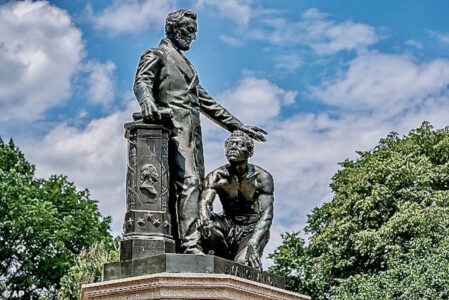
One person can make a difference. The Marietta Register April 20, 1865, 6 days after Abraham Lincoln was assassinated: "Charlotte Scott, a colored woman living at Dr. Rucker's on Putnam Street, Marietta, wishes to show…her profound regard and high veneration for Hon. Abraham Lincoln, especially in his proclamation of freedom to the slaves. She has handed me five dollars to be applied towards rearing a monument in memory of the greatest man, in her estimation, that ever lived on earth. This noble thought, so far as I know, originated with her… C. D. Battelle."Upon hearing that Lincoln was dead, Charlotte had reportedly exclaimed, "Lord have mercy – Mr. Lincoln is killed! He ought to have a monument and I am going to give the last cent I have for it."
Thanks to her and those who helped organize fundraising, $16,242 was raised – a considerable sum then but not enough. Several years later, there were sufficient funds, and a sculpture was created. According to the National Park Service, "the funds were collected solely from freed slaves (primarily from African American Union Army veterans)."
Dedication of the Emancipation Memorial, as it was named, took place on April 14, 1876, the date of Lincoln's death. That day had further symbolism; it was also Good Friday, the day of Christ's crucification. The ceremony was an amazing gathering of thousands in newly created Lincoln Park. Newspaper coverage included these headlines: The Tribute of a Grateful Race, An Immense Assemblage in Attendance, Beautiful and Enthusiastic Ceremonies, Abraham Lincoln – A Sad Anniversary.
A lengthy procession began on K Street, wound through the White House grounds, and eventually reached Lincoln Park. In the procession: dozens of Black fraternal organizations, bands, Colored troops, and the Metropolitan Police. The playing of "Hail Columbia" opened the ceremonies; the Star Bangled Banner was then played mainly at military events.
All 3 branches of the federal government were represented: President Ulysses Grant with cabinet members, Congressional leaders, and justices of the Supreme Court. How often do we see that now, except at State of the Union addresses? President Grant unveiled the flag-draped statue. The New York Herald: "The President gave one firm pull, ... and amid the deafening cheers and the booming of cannon…the beautiful monument stood unveiled." Then a poem was read, composed by a woman identified as "Miss Cordelia Ray, colored, of New York."
Famous Black orator Frederick Douglass addressed the crowd. He acknowledged that but for Lincoln and the Emancipation Proclamation, "...no such (gathering of Black people) would have been tolerated 20 years ago." His speech was glowing in praise of Lincoln: "A grateful colored people, newly emancipated and rejoicing in our blood-bought freedom, have...dedicated a monument of enduring granite and bronze (to) the exalted character and great works of Abraham Lincoln, the first martyr President of the United States."
However, Douglass also delivered a Lincoln "reality check" in his speech. "Abraham Lincoln was not, in the fullest sense of the word, either our man or our model." Douglass pointed out that Lincoln, at various times: wanted most to save the Union – with or without slavery; sought only to contain slavery, not abolish it; favored colonization (moving Blacks to colonies outside the US); and delayed allowing Black soldiers into the Union army. "Our faith in him was often taxed and strained... but it never failed."
George Harris was present at the dedication. He had witnessed the whipping death of slave Uncle Tom that inspired Harriet Beecher Stowe's iconic novel Uncle Tom's Cabin. Charlotte Scott, who had made the first donation, was there, too, filled with wonder and gratitude at what her initial action brought about.