
State, developers discuss future of data centers in West Virginia during Eastern Panhandle Lunch and Learn
Trending
MARTINSBURG -- Berkeley County business leaders, state officials and economic development experts gathered Tuesday for a Lunch and Learn hosted by the Martinsburg-Berkeley County Chamber of Commerce to discuss the future of data centers in West Virginia, especially the proposed $4 billion Bedington Data Center campus.
Representatives from Washington, D.C.-based Penzance joined state and regional leaders to outline plans for the massive development and address concerns ranging from infrastructure and power usage to water consumption and community engagement.
Founded in 1996 by Julie and Victor Tolkan, Penzance develops residential, industrial, office and data center projects throughout the Mid-Atlantic region. The company is now leading plans for the Berkeley County campus, which will span 548 acres and include 1.9 million square feet of development with 600 megawatts of power output.
The Bedington Campus has also been designated as a High Impact Intelligence Center, a new state classification aimed at attracting major technology and data infrastructure investments.
Lauren Kowall of Penzance said Bedington emerged as a prime location because of its proximity to Northern Virginia, widely considered the data center capital of the world.
"Bedington is close enough to Northern Virginia to support the growing demand in that market while also offering significant infrastructure advantages," Kowall explained. Among those advantages is the presence of the largest electrical substation in West Virginia.
John Kusturiss, partner with Penzance, said the existing infrastructure made the location ideal for the project.
First Energy has indicated there is more than enough power through the substation to provide whatever the user will need without causing an uptick in costs to local residents, Kusturiss explained. "This project doesn't cause rates to go up because capacity is already there." He added that while the project would utilize existing electrical capacity, it would also help modernize aging infrastructure in the area.
Questions surrounding water use were also addressed during the session. Kusturiss said the project intends to rely heavily on reclaimed water rather than potable water supplies.
Approximately 1.1 million gallons of treated wastewater from a nearby treatment plant are discharged daily into the Opequon Creek. Penzance plans to use that reclaimed water for as much as 60 percent of the campus' needs. The company also plans to construct a reclaimed water facility and on-site water storage systems to support operations during peak summer demand.
While Penzance has not yet announced the tenant for the facility, Kusturiss said interest in the project remains strong and an announcement is expected later this year.
Kusturiss also noted that Penzance has engaged West Virginia University economist John Deskins to conduct a formal economic analysis of the project. Early estimates project approximately $94 million annually in tax revenue.
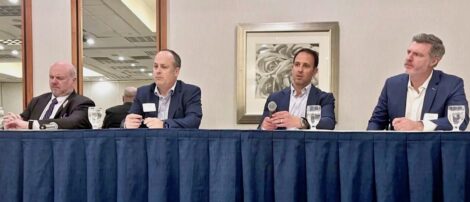
The panel discussion also featured Chris Morris, director of the West Virginia Data Economy Office; Cris White, partner with Penzance; and Buddy Rizer, executive director of economic development for Loudoun County, Va.
Morris, when explaining the new office he holds and its role in state government, emphasized that access to power is one of the primary drivers behind the growing interest of data centers in West Virginia.
"Data centers are all about access to power, and West Virginia is a power-generating state," Morris said. He explained that successful projects must meet several criteria, including site control, compatibility with nearby uses, access to power and a comprehensive water usage plan.
Morris also highlighted the role of House Bill 2014, the Power Generation and Consumption Act, which helped create a pathway for the project by establishing a certified microgrid program intended to expand power generation and support economic development.
However, Morris stressed that the legislation does not exempt projects from oversight. Companies pursuing data center developments must still work with permitting agencies including the West Virginia Department of Environmental Protection, the State Historic Preservation Office and other regulatory entities, he said.
Morris acknowledged that communication with local residents during the early stages of the project could have been stronger.
"We have not communicated as well with local folks as we could and we will do better," Morris said.
Looking ahead, Morris said the state plans to issue a Request for Information seeking additional sites in communities interested in hosting data center developments.
"A lot of counties want these projects," he said.
He also discussed the possible formation of an advisory council to provide broader public input regarding future data center development in West Virginia.
Drawing from Loudoun County's experience, Rizer shared lessons learned from overseeing one of the world's largest concentrations of data centers. He said successful projects require six essential components: land, power, utilities, a favorable business environment and workforce availability.
In Loudoun County, commercial business tax revenue has grown dramatically over the past two decades.
"In 2007, 19 percent of the county's revenue came from commercial businesses. Now it's 51 percent," Rizer said.
He added that data centers alone now account for 45 percent of Loudoun County's tax revenue while occupying only 3 percent of the land area. Although the industry did not create a massive number of jobs, Rizer said the financial benefits have been significant, generating approximately $1.2 billion annually.
He also pushed back against common concerns about utility impacts.
"Electric bills have not gone up in Loudoun because of data centers," Rizer said, adding that local air quality has improved over time and data centers account for less than 10 percent of the county's water usage.
Throughout the discussion, transparency and community engagement emerged as recurring themes.
"There is an opportunity here to get to know each other," Kusturiss said. "Our best references come from local governments and communities where we've worked, and we want to make sure that happens in Berkeley County."
Penzance officials said they plan to begin meeting with local stakeholders in the coming weeks as the project advances.
Rizer also emphasized that community support depends heavily on transparency, a sentiment echoed by Morris.
"This is all new to West Virginia and conversations need to be had as early as possible," Morris said.
Kusturiss closed the discussion by reaffirming the company's long-term intentions in Berkeley County.
"We want to be a good long-term partner," he said. "We want this to be a great experience."