
Marietta council committees discuss Start Westward Monument foundry proposal, partnerships and funding transfers
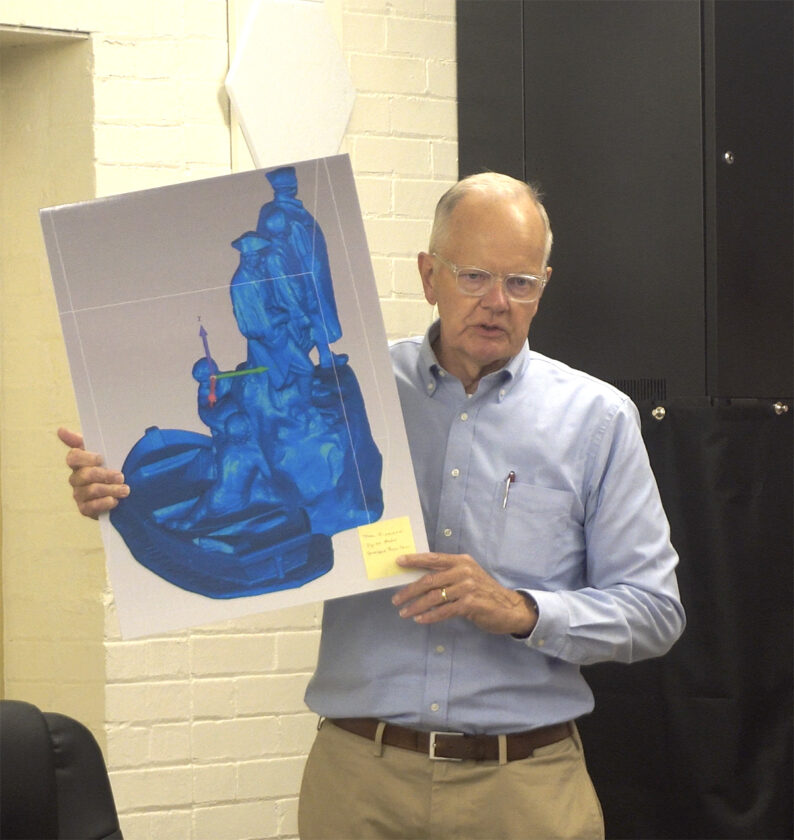
Fred Smith, project manager, discusses the 3D scan of the Start Westward Monument during a committee meeting Thursday evening. (Photo by Gwen Sour)
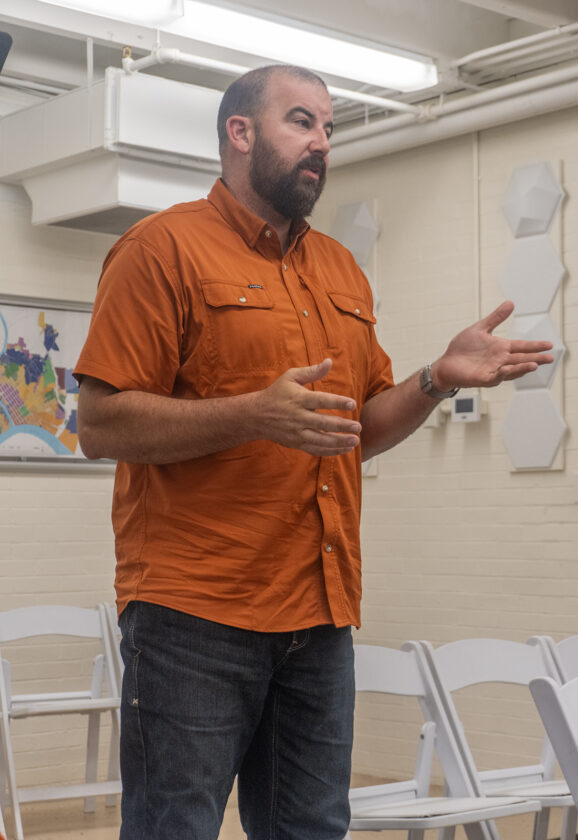
Jesse Roush, president and CEO of the Southeastern Ohio Port Authority, discusses collaborative efforts regarding grants during a committee meeting Thursday evening. (Photo by Gwen Sour)
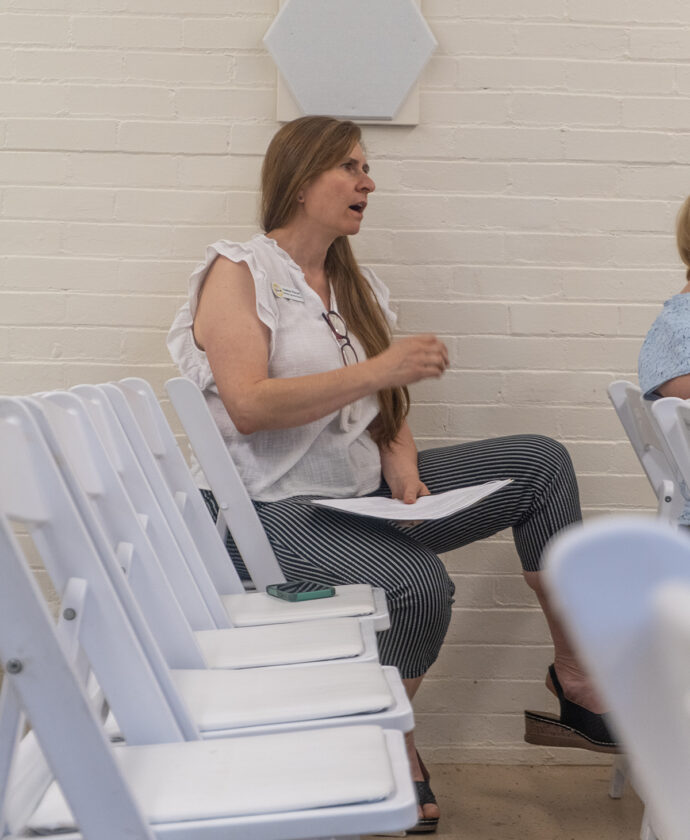
Heather Warner, executive director of GoPacks discusses the benefit of community involvement and support from the city and how it impacts grant funding. (Photo by Gwen Sour)
Fred Smith, project manager, discusses the 3D scan of the Start Westward Monument during a committee meeting Thursday evening. (Photo by Gwen Sour)
Jesse Roush, president and CEO of the Southeastern Ohio Port Authority, discusses collaborative efforts regarding grants during a committee meeting Thursday evening. (Photo by Gwen Sour)
Heather Warner, executive director of GoPacks discusses the benefit of community involvement and support from the city and how it impacts grant funding. (Photo by Gwen Sour)
Trending
MARIETTA -- Marietta City Council committees discussed the future of the Start Westward Monument, several financial transfers and the value of community partnerships during meetings Thursday evening.
Public Lands, Buildings and Parks Committee Chairwoman Katie McGlynn then opened discussion on the Start Westward Monument, with Fred Smith giving council members an update on the bronze sculpture project.
Smith, who said he has been hired by the city as an adviser on the project, said work has focused on comparing a 3D scan of the existing monument with historic images showing what the sculpture looked like when it was newly completed in 1937.
Smith said the existing stone sculpture is heavily eroded, particularly in the faces, and said those details are important to the overall impact of the work.
"The faces really convey the artwork and the emotion," Smith said. "If we can get the faces right, then this will be a successful project."
Smith said McKay Lodge Conservation Laboratory helped scan the existing sculpture and create a digital model. He said the next step is to complete a wax model that can be reviewed by a conservator before being used to cast the sculpture in bronze.
Smith said there is some urgency because McKay Lodge is closing and the city's contact there is expected to retire soon. He recommended completing the planning portion of the work with McKay Lodge, then issuing a request for proposals, a formal process used to solicit plans and prices from contractors, for foundry services rather than attempting to shift the existing contract to another contractor.
Smith said the foundry work should be handled through a formal proposal process because the project involves public money and specialized work.
"Keep it on the up and up. Follow the rules," Smith said.
City officials said legislation would be needed to authorize issuing the request for proposals, with the document attached as an exhibit. Members of the Public Lands, Buildings and Parks Committee agreed to request legislation for the proposal process.
Smith said several agreements tied to the project are still being reviewed, including a cooperative use agreement and a memorandum of understanding involving the state, the city and the Ohio History Connection. He said a separate site management agreement is no longer expected to be needed, and officials have been told a lease is not necessary because the monument would be placed on public property.
Smith also said maintenance requirements would likely be included in the memorandum of understanding. He estimated bronze maintenance could cost about $6,000 to $9,000 a year for cleaning and waxing three times annually, though city staff could be trained to help reduce costs.
Smith said he did not have final budget numbers Thursday, but a preliminary foundry estimate was favorable. He said the project appeared to be within previously identified funding, including $500,000 through the Ohio History Connection, $150,000 in American Rescue Plan Act funds and $100,000 in state capital funding. Additional state funding has also been requested for related improvements such as sidewalks, plantings, lighting and interpretive signs.
Grimm asked Smith whether a lease would be needed and whether Smith expected additional costs for helping the city work through state requirements. Smith said the state had indicated no lease was needed and said his work with state officials was included in his existing fee.
During a Planning, Zoning, Annexation and Housing and Finance discussion, Community Development Director Geoff Schenkel led a broader conversation on the value of partnerships with groups including the Port Authority, Building Bridges to Careers and GoPacks.
Schenkel said those partnerships extend what the city can do with limited staff and resources.
"These are current partners, potential partners, and they have extended the reach of what the city is capable of doing on its own," Schenkel said.
He said the partnerships help the department manage "in the neighborhood of $18 million of work this year" by connecting the city with outside expertise, staffing capacity and funding opportunities.
Jesse Roush, president and CEO of the Southeastern Ohio Port Authority, speaking about the Historic Harmar Bridge Company, said formal public-private agreements have helped make projects more competitive for funding. He pointed to a joint use agreement involving the Harmar Bridge as an example.
"I look at the joint use agreement as a true one plus one equals three sort of arrangement," Roush said.
He said the agreement helped support a $50,000 pier assessment and later funding efforts tied to the bridge and other connected projects.
Pamela Lankford, Epicenter director for Building Bridges to Careers, said partnerships are especially important in small rural communities. She said Building Bridges to Careers has worked with schools, businesses, nonprofits and regional groups to support internships, including high school tech internships and other workforce development programs.
Safety-Service Director Steve Wetz said a Building Bridges to Careers intern helped the city study transit routes during the COVID-19 pandemic, giving officials information they later used in discussions with Community Action about modernizing the transit system.
The committee also discussed the Residential Revitalization Program, including work around Pearl Street, Ward Street and other properties. Officials said the program has helped turn relatively small local investments into larger housing and redevelopment efforts, including a planned $20 million, 65-unit senior housing project.
Speakers said the program has also helped with demolition funding, property acquisition and technical assistance for property owners pursuing new housing or revitalization projects.
Heather Warner of GoPacks said collaboration has helped her organization secure grants and broaden its work with students and families. She said GoPacks works with more than 40 organizations annually and provides training and support to community partners.
Schenkel said he would like to return for another discussion on neighborhood planning and how it could support the city's existing development work.
During a Finance Committee discussion, Councilman Jon Grimm reviewed several transfers and appropriations expected to move forward, including a budget stabilization transfer that he said would bring the account's cash balance to just over $2 million.
Other items included a $62,500 transfer for the city's first installment to the Southeast Ohio Building Department, transfers related to insurance claim payments for vehicle repairs and a $13,760 transfer from OBI enforcement education funds for supplies and materials. Grimm said the insurance-related transfers were tied to five vehicle damage repairs.
Municipal Court also requested funds from Court Special Projects for new flooring and three desks for probation. Grimm said the request involved moving court funds internally.