
The Shadow-Catcher has come: Marietta’s early daguerreotypists
Trending
In today's high-tech world, we take for granted the ease with which photos of family, friends, scenes, and events may be captured. Cellphones, equipped with digital cameras, are always with us, ready to snap hundreds of pictures, many of which are discarded or never looked at again.
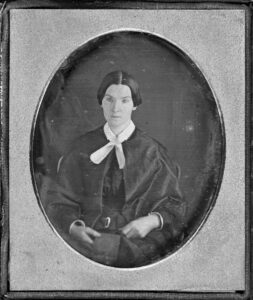
During the 19th Century, however, every photograph was a treasure to be displayed and preserved for all time. People were urged to have a "faithful resemblance" made before a loved one departed, perhaps forever. One daguerreotypist in early Marietta advised, "Secure the image 'ere the object is no more."
After many years of experimentation, the ability to create a lasting image from life was invented by French artist and physicist Louis Daguerre and shown to the public in 1839. Daguerre discovered that exposing a polished sheet of silver-plated copper in a camera obscura would create a permanent image if the image was treated with mercury vapor, then fixed by a salt solution and sealed behind glass.
This remarkable photographic process quickly crossed the ocean and spread throughout the United States by way of instructional booklets. Daguerreotype studios were established in large cities, and traveling daguerreotypists hauled their equipment to outlying areas on horse-drawn wagons or riverboats. This was no easy task, as their gear included a large, wooden camera, photographic plates, and developing chemicals.
One of Marietta's earliest daguerreotypists was C. F. Buckminster, who came to town in 1842. Buckminster described the superiority of his daguerreotypes in the newspaper, saying that "the fault" with most "likenesses" could be seen in the "dull and unnatural" eyes of the subject. His methods corrected that issue and reduced the sitting time for a portrait. Clients were accommodated in a temporary studio at the Exchange Hotel in Harmar.
In 1848, Marietta was visited by daguerreotypist Anthony Jaquay, who proudly announced, "The Shadow-Catcher has come!" Jaquay advertised his "Floating Gallery," a flatboat called the Artist, which was moored at the foot of Front Street. Precision, clearness, and depth of tone were guaranteed. Jaquay offered group portraits and miniatures for rings and lockets.
D. L. Williams, a daguerreotypist from Philadelphia, set up his gallery over the store of Bosworth, Wells & Co. on Front Street in 1848. Having studied in Europe, Williams was experienced as both a camera operator and teacher. In addition to photographing local residents, he provided "a theoretical and practical knowledge of this wonderful art . . . on easy terms" to anyone who wished to learn.
Just as with today's electronics, the daguerreotype process rapidly underwent significant improvements. While early daguerreotypes required the subject to sit motionless for up to 30 minutes, by the mid-1840s the time had been reduced to 30 seconds or less. Originally, daguerreotypes could be created only on sunny days, but soon pictures could be taken in any kind of weather. The cost of a daguerreotype in an "elegant case" ranged from $1 to $6 in the 1840s (about $100 today), but by the 1850s, the most frequently quoted price was 50 cents ($20 in 2023).
When compared to oil portraits, the time and cost of daguerreotypes made them extremely popular. By 1855, Anthony Jaquay had traveled the Ohio River from Pittsburgh to New Albany, Indiana, and taken over 20,000 pictures.
Linda Showalter is a member of WCHS. To learn more about Washington County Historical Society services and membership, call 740-373-1788 or visit wchshistory.org