“Schools and means of education shall forever be encouraged,” Ordinance of 1787
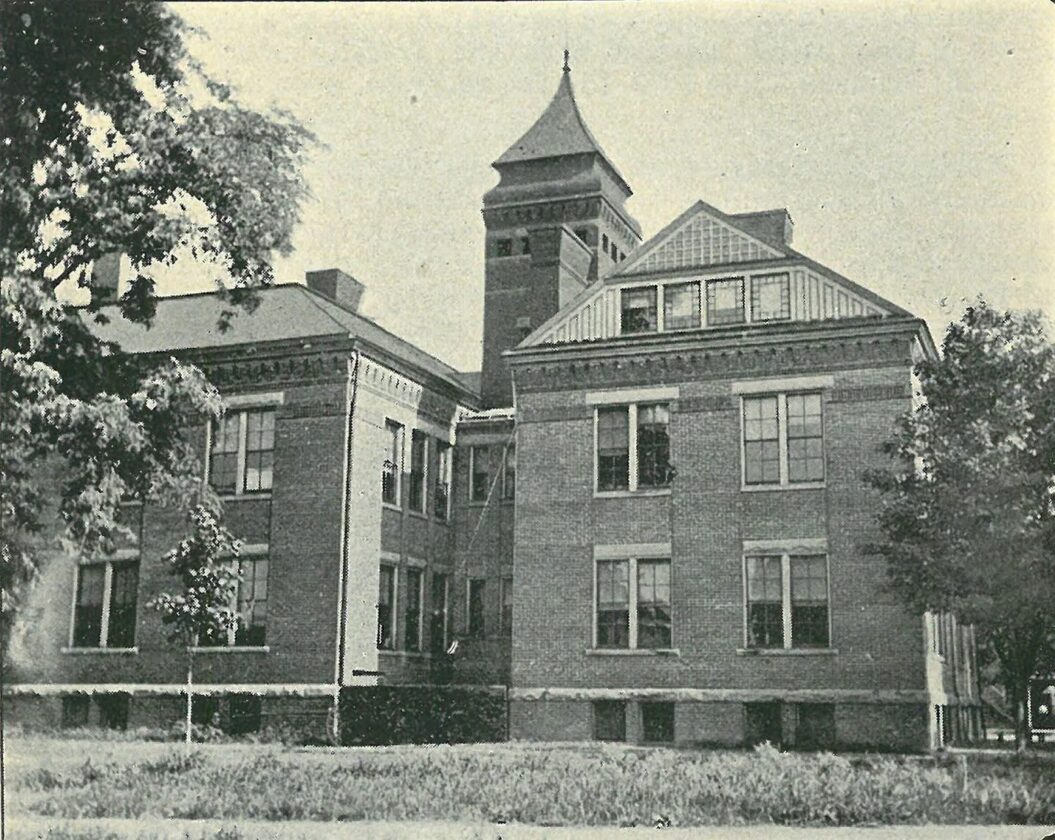
Fort School, predecessor of today’s Harmar School, built in the 1890s. (Photo provided by Harmar Village)
Every settlement in Washington County provided schooling early on. Marietta started classes taught by Major Anselm Tupper in the winter of 1789-90. Joseph Barker: “Tupper had a genius & Capacity & taste for literary pursuits.” The same Joseph Barker, master builder and businessman, also taught school in 1793-94 in Stone’s Garrison at Belpre. The first schools were often in private homes. A Mr. Curtis held classes in his barrel-making shop at The Point. Young Nancy Allison recalled the Campus Martius stockade school ” was kept every day of the week, both summer and winter.”
Teachers were paid little. Schools were supported by residents, with limited funding from the Ohio Company. Teachers in Belpre earned $5 per month. Ephraim Cutler negotiated a detailed written contract with a teacher in Warren Township near Constitution OH at $25 per calendar quarter. Best laid plans: the teacher signed the contract but quit after a week. Dang.
A typical schoolhouse in the early 1800s was a crude log structure with benches (no seatbacks!), a fire place (students near the fire roasted, those far away froze), puncheon floors, mud “chinking” between logs to keep out weather, a small window or two, and an outhouse. Shelves along the walls served as desks. All students were taught together, from age 5 to 18.
Ephraim Cutler fought for free, universal education, as practiced in his native Massachusetts. He worked for years in the Ohio legislature to establish schools funded by property taxes. Finally, “An Act to Provide for the Support and Better Regulation of Common Schools” was passed in 1825. Cutler was exuberant; he compared the law’s passage to Simeon’s lifelong wait to see the Christ child in Luke 2:29. The law required that teachers be tested for qualification. Notice April 1, 1825: “…the following gentlemen were appointed Examiners for the County of Washington…William Slocomb, of Marietta, William P. Putnam, of Belpre. Anselm T. Nye. Esq. of Waterford.
Each township was required to establish a school district. The Ohio State Journal urged compliance as “essential to the interests of the rising generation.” Hundreds of community volunteers, many of them prominent citizens, became involved in schools. In 1837, the Washington County School Association was founded for “promoting the interests of Common School Education.” They met semi-annually. Some examples of topics were “best methods of teaching reading and grammar; introduction of Vocal Music, Natural Science, and Science of Agriculture; Construction of School Houses.” At meetings “no speaker could occupy the floor more than 15 minutes at a time.” They must have had long meetings.
Discipline was a frequent topic. One policy recommended that “…discipline be maintained by moral persuasion…corporal punishment (should be a last resort)”. Teacher William Slocomb meted out severe punishments early in his career; later he advocated milder discipline. At one meeting, a former student mocked Slocomb’s change of heart. The student noted that trees near Slocomb’s school were barren of branches that he had cut for switches. Slocomb heard the comment; he retorted that he never knew whether students’ punishment was too much or too little, but in that student’s case – “either was a failure.”
In 1849, a major step in Marietta was adoption of a “union plan,” which combined smaller districts (there were 5 in Marietta alone). This allowed introduction of graded schools (students grouped by grade level) and formation of a high school. Gradually similar changes were introduced in other townships. A Teachers Institute was established in 1851 to better train teachers; 104 teachers enrolled. Teachers learned the best teaching methods, subject knowledge, and morality. This was similar to continuing education programs today.
We can be grateful for the energy and passion that so many devoted to better education.
Local Columns
Impressions of Turkey
The Shale Crescent USA Team is part of a U.S. Commercial Services Roadshow to Turkey. Lynnda and I, along with ...
Laws of the land
As we prepare for America 250, the celebration of the signing of the Declaration of Independence in 1776, we begin ...
“Schools and means of education shall forever be encouraged,” Ordinance of 1787
Data centers: Where’s the beef?
Data centers are growing exponentially all around the country. One is being discussed in Washington County, Ohio. ...
Matthews left a good impression on Marietta