
The Way I See It: Titanic sinking continues to captivate the public 114 years later
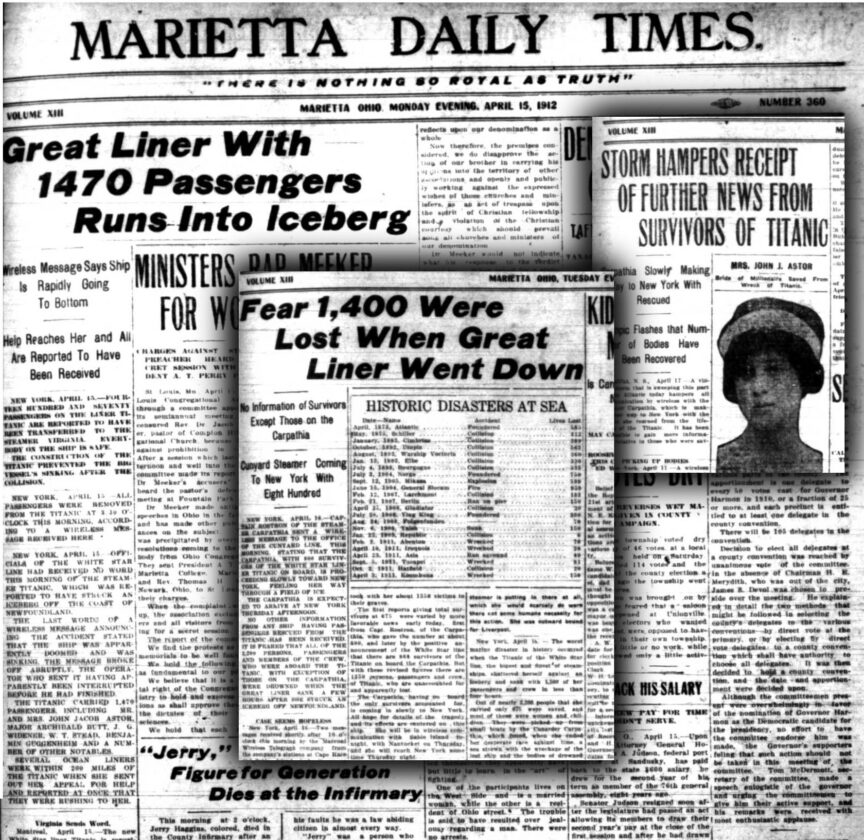
(Photo provided)
When the great ocean liner Titanic hit an iceberg and sank in the north Atlantic on April 15, 1912, it set off a media frenzy and a public obsession that still rings true today.
The lack of reliable communications proved to be not only a factor that hindered recovery efforts, but also led to confusion on land as to the severity of the accident. Commercial radio was still years away. For consumers, the press meant just that. Newspapers coverage of the offshore disaster relied on what would become the next mass media, radio, to get news from the middle of the ocean. Developed to communicate with ships at sea by Guglielmo Marconi, radio provided a way to get news from the disaster and played a huge part in coordinating the rescue efforts.
Radio was still an immature medium, and errors made that day led to confusion and loss of life.
A radio operator aboard the ship the Californian attempted to warn the Titanic at 9:05 p.m. of thick ice but was rebuffed for jamming the radio waves. The two ships were just 20 miles apart. He turned the radio off and went to bed at 11:30 so he never heard the Titanic’s call for help. The captain woke him up at 3:40 a.m. when they spotted distress flairs. By then the Titanic was already on the ocean floor and its passengers were left freezing to death in the ocean. The Carpathia did receive the distress signal from the Titanic and traveled nearly 60 miles to reach the at least705 survivors that it plucked from the icy north Atlantic.
Another radio error led to a colossal mistake in newspapers across the country, including The Marietta Times.
The headline of The Times on April 15 read “Great Liner With 1470 Passengers Runs Into Iceberg. Wireless Message Says Ship is Rapidly Going to Bottom.” “Help Reaches Her and All are Reported to Have Been Received.”
The newspaper accurately reported that an iceberg had been struck off the coast of Newfoundland and that the radio operator had announced that the ship was “apparently doomed” and was sinking.
Another message intercepted reported that all the passengers were safe, but those were the passengers aboard another ship that had floundered and was being towed to Halifax. They were OK, they were just not the Titanic passengers.
In the chaos of many people communicating aboard the same radio waves, the message was misidentified as being from the Titanic and then reported in newspapers all over the world.
By the next day, The Times carried accurate news that there was massive loss of life. The Times reported on April 16 that 800 survivors were en route to New York on the Carpathia, but that the prospects for the remaining 1,400 were dim.
It is likely the Carpathia actually rescued as many as 712 people from the lifeboats when it arrived two hours after the Titanic went down.
The loss of life is estimated to have been around 1,500 making it one of the deadliest peace time naval disasters.
Even though it happened more than 110 years ago, the public has really never lost interest in the sinking of the great ocean liner Titanic.
The 1997 epic film set box office records even though the whole world knew the outcome. The exhibition of artifacts at museums and traveling shows around the country still attract large crowds.
The ship sank in 12,000 feet of water in the north Atlantic. The broken ship sat in pieces on the ocean floor, not to be seen again until 1985 when Robert Ballard used a remote-controlled submersible to reach the vessel and photograph it on Sept. 1, 1985. It was the first of many trips that small submarines, both manned and unmanned, would make to the sea floor.
Explorers, scientists, filmmakers, tourists, and salvagers have removed thousands of artifacts from the huge debris field that covers 15 square miles of the sea floor. These items are now displayed worldwide. In 2023 a submersible named Titan imploded during a trip to view the wreck, killing the 5 people that were aboard.
Art Smith is online manager of The Parkersburg News and Sentinel and The Marietta Times, he can be reached at asmith@newsandsentinel.com
Local Columns
MOV Climate Corner: Public lands need protection
For the first eight years of my life, our family lived in a small rented house in Steubenville, Ohio. We had a tiny ...
Cracking the Code: Good thoughts to ponder
As I write this, we are leaving Puerto Plata, Dominican Republic, after a pleasant visit. Lynnda and I left Easter ...
The Way I See It: Titanic sinking continues to captivate the public 114 years later

The last men
Backyard Gardener: Ornamental trees to replace the Callery pear
Hello Mid-Ohio Valley farmers and gardeners! Everyone is enjoying the beauty of spring flowering trees and shrubs ...
MOV Climate Corner: No kings, no exceptions
By Jean Ambrose Easter is the most important day in the year for Christians. It commemorates the state torture ...