How it works: Applying rumble strips

Photo by Michael Kelly A sweeper follows the truck cutting rumble strips on Ohio 60 north of Beverly Tuesday afternoon, removing debris from the operation.
-
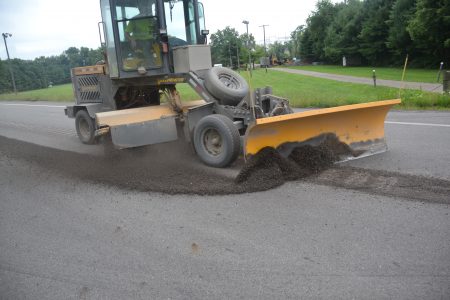
- Photo by Michael Kelly A sweeper follows the truck cutting rumble strips on Ohio 60 north of Beverly Tuesday afternoon, removing debris from the operation.
-
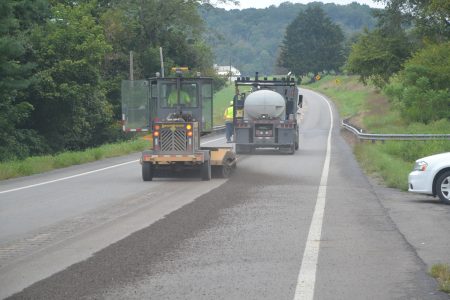
- hoto by Michael Kelly A Boca Construction truck specially fitted to cut rumble strips, followed by a sweeper, makes its way up Ohio 60 north of Beverly Tuesday afternoon.
-
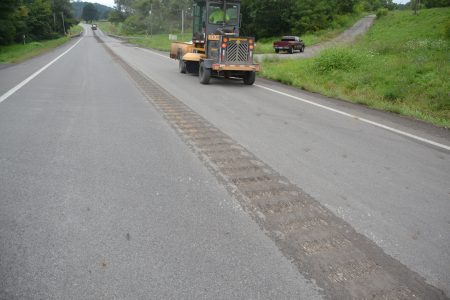
- Photo by Michael Kelly A line of rumble strips is cut by specialized equipment as part of a 30-mile project on Ohio 60 to reduce the potential for collisions caused by vehicles crossing the centerline. Ohio Department of Transportation crews will repaint the center stripe.
-
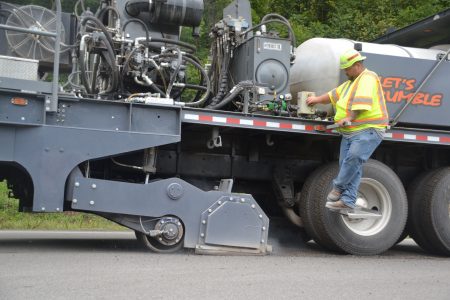
- Photo by Michael Kelly A worker on a Boca Construction truck operates the milling module that cuts centerline rumble strips north of Beverly on Ohio 60 Tuesday afternoon. The company was contracted by the Ohio Department of Transportation to cut about 30 miles of the traffic-safety installations in an effort to reduce the number of collisions caused by vehicles crossing the center line.
The process is fast, simple and cheap in relation to the number of lives it could save.
It involves two vehicles – a large truck equipped with a mechanical milling module that cuts grooves about half an inch deep and several inches wide, spaced a few inches apart, into the center line pavement. The truck, a modified Kenworth tanker chassis, has a driver-operator in the cab and a milling machine operator on a small platform, who closely watches the module. Behind the truck a smaller vehicle equipped with a blade and a rotary sweeping attachment clears the shredded asphalt debris off the roadway.
Traffic disruption was minimal as vehicles were either stopped briefly by flaggers or directed to pass the crew.
The rumble strip project originated when the Ohio State Highway Patrol post in Marietta expressed concerns about the number of crossed-center line crashes, most of them head-on, that had been occurring on Ohio 60 north of Marietta, Ohio Department of Transportation spokesman Matt Bruning said. The department had seen success with center line rumble strips in other locations and thought it would be effective in this area, he said.

hoto by Michael Kelly A Boca Construction truck specially fitted to cut rumble strips, followed by a sweeper, makes its way up Ohio 60 north of Beverly Tuesday afternoon.
Rumble strips, most often seen on the outside edges of interstate highways, alert drivers that they are drifting off the road. When the tires of the vehicle roll over the indentations, the alarming sound gets the attention of the driver, who can then correct the vehicle’s course before it runs off the pavement. Center line rumble strips have the same effect, but are used down the center of two-lane high speed rural highways to prevent drivers from drifting into oncoming traffic.
The Ohio 60 project installed about 30 miles of center line strip from north of Devola to within two miles of McConnelsville. Bruning said the project skipped through villages to minimize noise complaints in low-speed areas. Beyond McConnelsville, he said, a paving project will incorporate center line rumble strips as the asphalt is laid.
“By the end of summer, this road will have the strips from Devola to the Muskingum County line,” he said.
Rumble strips, since they were first used in New Jersey in 1955, have proven a cheap and effective way to reduce the number of crashes caused by vehicles drifting out of their travel lanes. And the technology for creating them is basic and mechanical.
Aiden McDonnel is president of Boca Construction in Norwalk, the company that performed the Ohio 60 job and most others in the state. Although the rumble strip machinery is available for purchase through truck retrofitting specialty companies, McDonnel said Boca designed and built its own.

Photo by Michael Kelly A line of rumble strips is cut by specialized equipment as part of a 30-mile project on Ohio 60 to reduce the potential for collisions caused by vehicles crossing the centerline. Ohio Department of Transportation crews will repaint the center stripe.
“It’s a custom machine, one of a kind,” he said.
The device works like a router, with a cutting head that plunges into the asphalt and grinds out grooves, while applying water to keep the dust down. The truck is equipped with one module on either side, a safety provision that allows it to cut center line or edge line rumble strips and still move with the traffic flow, he said. The truck driver positions the truck to line up the cutter correctly on the road, and the operator on the platform controls the depth of the cut, he said.
“It’s the fastest operation we’re aware of,” he said.
The job requires expertise and precision.
“It’s a final product, in a lot of ways the last service applied to many paving projects, and you don’t want to have to go back and redo the paving,” he said. “We need our guys to be perfect.”

Photo by Michael Kelly A worker on a Boca Construction truck operates the milling module that cuts centerline rumble strips north of Beverly on Ohio 60 Tuesday afternoon. The company was contracted by the Ohio Department of Transportation to cut about 30 miles of the traffic-safety installations in an effort to reduce the number of collisions caused by vehicles crossing the center line.
The driver, Larry Knudson, has been doing the job since the truck came into service in 2001, and his son, Harley Knudson, is the outside platform operator, McDonnel said.
“They travel all around the state and to all the states surrounding Ohio,” he said. “They keep very busy.”
The final touch on the project will be repainting the center stripe, Bruning said. Because of the grooves in the pavement, the center stripe will have to be applied twice, once in each direction, to cover the entire cavity of each groove and keep reflectivity in both directions.
Eric Davis, an administrator with ODOT District 10, said the contract with Boca is about $40,000, an amount that doesn’t include the painting or the flagging crews provided by ODOT.
“We don’t include those costs because if the flagging crews weren’t doing this, they’d be working on some other project,” he said.
Bruning said a similar project took place on Ohio 93 in Vinton County, where in 18 months three fatal crashes had occurred because of vehicles crossing the center line. Since 2015 when the project was completed, none have occurred, he said.
“It’s an idea that we know works,” he said.
Michael Kelly can be contacted at mkelly@mariettatimes.com.
Rumble strips
• First used in New Jersey in 1955.
• Shown to reduce collisions involving vehicles crossing the center line by 18 to 64 percent, depending on location, type of strip and study methodology.
Sources: Times research.
Local News
Ohio lawmakers pass bill to increase penalties for passing a stopped school bus, add cameras
Ohio lawmakers passed a bill last week that increases the penalties for illegally passing a stopped school bus. ...

Belpre Homecoming reveals entertainment lineup for 94th year
Marietta College interns research Opportunity Zone in Appalachian Ohio
MARIETTA – Six Marietta College student interns are studying economic conditions in five Ohio counties this ...
Mid-Ohio Valley Safety Council to hold Safety Celebration event tomorrow
The Mid-Ohio Valley Safety Council will hold a Safety Celebration from 11 a.m. to 1 p.m. at the Marietta Shrine ...
Artsbridge Calendar of Events
The Artsbridge Calendar of Events for the week. Today: 2026 Middle School STEAM Camp, free, BB2C Makerspace, ...