
The Castle hosts Third Thursday talk: Mayle shares Marietta’s untold history during event
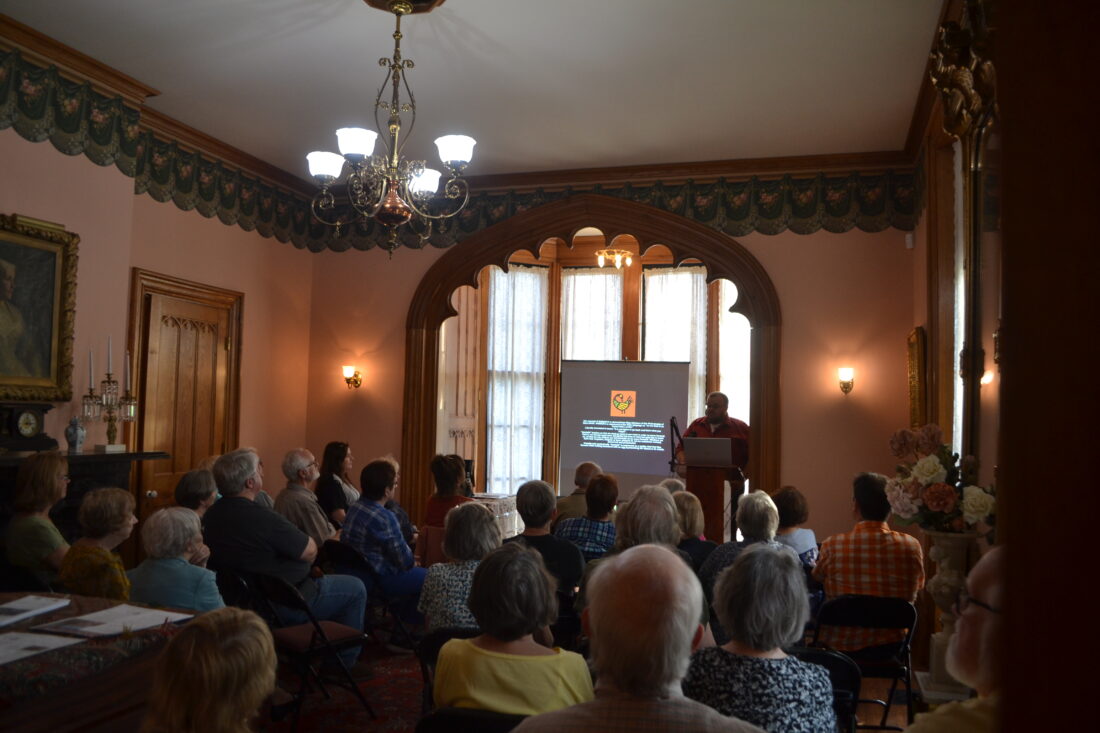
(Photo by Douglass Huxley) Photo by Douglass Huxley Tony Mayle speaks to a crowd Thursday night at the Castle about the history of the region related to the abolitionist movement and the involvement that Washington County residents and Marietta College had on the movements for freedom in the 1800s.
The Castle in Marietta held its Third Thursday Talk with guest speaker Tony Mayle on Thursday night.
“There’s a lot of history, hidden history or untold history, that hasn’t been shared for a long time,” Castle Executive Director Scott Britton said.
“That’s the great thing about these types of programs, is we are able to offer that to the community. To learn more about our hometown, and the prominent roles it played in changing not only our local history, but our state and national history as well,” he said.
Mayle discussed the history of the region related to the abolitionist movement and the involvement Washington County residents and Marietta College had on the movements for freedom in the 1800s.
Mayle was born and raised in Southeast Ohio and has been involved in local and regional diversity efforts. He has presented at conferences throughout the country on the topic of diversity and inclusion of all populations.
“Whenever I give these discussions on this topic I let people know that this is research I’ve done,” Mayle said. “So, other families, and your research, may be a little bit different from mine.”
Mayle said African American or Native American culture was identified through many different hues.
“It mattered who the census taker was, if they knew the family, and how they identified racially,” Mayle said. “Some years the family members could be labeled as ‘C’ for colored, sometimes ‘W’ for white, sometimes ‘I’ for Indian, and sometimes ‘N’ for Negro.”
Mayle said the spelling of last names could be different over the years as well.
“Sometimes the name change allowed them to identify as another race,” Mayle said. “They were light complected and some could pass as white by changing the spelling of their last name.”
Mayle talked about how the Ohio River played a big part in the Underground Railroad and emancipation. He said the Ohio River was referred to as “The River Jordan” and it stood on the edge of the Mason Dixon Line, dividing the slave states south of it and the free-soil states north of it.
“One could obtain freedom if they made it across the Ohio River,” Mayle said.
He said in the early days, before W.Va. split off from Virginia, there were plantations across the river from Marietta.
“We’ve seen stories that sometimes, those held in bondage, or enslaved people, would be borrowed for the day to do work in Marietta and then transported again later that night back to the plantations. So, that close to freedom, and yet, cannot get free.”
Mayle said there were around 30 stations along the Underground Railroad in Guernsey, Morgan and Washington counties. There are probably more that haven’t been discovered or talked about yet, he added.
Mayle said Marietta College was founded in 1835 and was one of the first colleges in the United States to accept women in 1864. He said this paved the way for more inclusion and diversity in the years that followed.
Mayle said in 1835 Theodore Weld, an American antislavery crusader in the pre-Civil War period, visited Marietta College and that many of the students attended his talks. He said the Kansas-Nebraska Act of 1854, which allowed settlers of a territory to decide whether slavery would be allowed within a new states border, lead to students flying the American flag upside-down, and at half mass, on the campus in protest on July 4, 1854, and the ringing of the college bell for an hour and a half.
“As you might expect, they received a lot of criticism for doing this,” Mayle said.
Mayle talked about some of the stations in the area, like the Stone House in Belpre ran by Captain John Stone, and the William Smith farm on Ohio 555 that was in operation from 1825-1861. He said the more prominent abolitionists in Marietta included David Putnam Jr., but there many members of the Anti Slavery Society involved.
Mayle talked about George Harrison, a free African American who has a building at Marietta College named after his family, who would help freedom seekers in Western Washington County at a moment’s notice. Mayle said Harrison lived at 308 Maple St. on land sold to him by David Putnam Jr.
Mayle read a letter Harrison wrote where he described carrying four freedom seekers from the Cutler House to the head of Vienna Island, located across from Vienna in West Virginia and Veto Road in Ohio.
“To John Walton who lived in Barlow Township,” Mayle read. “We had them cover with a quilt and bag so we had grain. I used to take slaves to a colored man on March Run Road.”
Mayle said Harrison seemed to have been thought highly of by the community, based on his obituary, and that his brother, Charles Sumner Harrison, was the first black student to graduate from Marietta College in 1876.
Mayle ended with a quote from Dr. John Henry Clark that says, “History is a clock that people use to tell their political and cultural time of day. It is a compass they use to find themselves on the map of human geography. It tells them where they are, but more importantly, what they must be.”
Douglass Huxley can be reached at dhuxley@newsandsentinel.com
Local News
Around Town
Shop, Swap and Stroll The next Shop, Swap and Stroll event will be held today. The event is a shopping, dining ...
Local woman advocating for MAID legislation
Election Day: Washington County residents head to the polls
Final, unofficial primary election results
Final, unofficial results from Tuesday's primary election, released by the Washington County Board of ...
The Castle’s Historic Tour of Homes returns Memorial Day Weekend
The Historic Tour of Homes presented by The Castle will take place again this year May 23 and 24. The tour of 11 ...
Local events
Meetings ¯ The OneOhio Region 12 committee meeting will be at 10 a.m. Friday held virtually via Teams. The ...