
Wood County schools incorporates new student online safety program
Trending
PARKERSBURG - Wood County Schools will be using a new student online safety initiative, Cyber SWAT (Safety While Accessing Technology), designed to meet federal Children's Internet Protection Act (CIPA) requirements and comply with West Virginia Senate Bill 466.
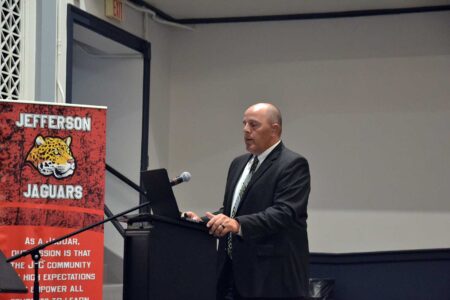
Jonathan Farley, director of information technology, told the Wood County Board of Education Tuesday night that the new program fits into long‑standing obligations around student internet safety and critical technology funding.
"In 2000 Congress enacted the CIPA requirement, Children's Internet Protection Act ... to protect children from obscene and harmful content," Farley said.
He said that CIPA compliance is not optional, as it is directly tied to E‑Rate, a key federal funding source that pays for school internet infrastructure. He said E-Rate is important to the school system's technology capabilities.
"E‑Rate is a special pot of funding that I use to upgrade our infrastructure, for our networks, to keep us going in the right direction," Farley said. "That money can only be spent for that, so we utilize that very, very carefully and maximize all of that."
He noted that this funding underpins much of the everyday functions of the district.
"That funding keeps our county technology infrastructure built up the way it is," he said. "Our wireless internet, our computer labs are wired up, our switches, everything touches it. The air this year that's running tonight is running through that."
Harley explained that Wood County has long used various programs to meet CIPA requirements, however, Senate Bill 466 required the West Virginia Department of Education to create a new statewide program focused on safe technology use.
"In 2024, it came into play and basically said, 'Hey, West Virginia Department of Education, you need to develop a safety while accessing technology education program,' hence the Cyber SWAT," Farley said. "The Skill program was selected to satisfy the requirement of Senate Bill 466 by the West Virginia Department of Education. Wood County had no play in that."
He said the Cyber SWAT requirement is being met through Skyll, an interactive simulation game students access with their school accounts.
Farley demonstrated how the program works with a short video saying the game turns the digital safety lessons into interactive choices, helping students experience real-world consequences.
"Each course is designed as a narrative adventure that teaches critical life skills such as digital safety through immersive story-driven gameplay," he said.
Students will create and customize a character, who becomes the main figure in a series of episodes.
"Each episode is broken into scenes, and it'll walk you through the first one so students advance step-by-step by clicking through the game," he said.
The scenarios are designed to look and feel like common online experiences, but with hidden risks.
In one example, the main character receives a message from a stranger online.
"The main character then receives a social media message from an unknown person asking them to meet in an alley. At this point, the student must make a choice: agree to meet in the alley, suggest a public place, or reject and report the message," the video said.
Even seemingly safer choices are used to teach caution.
"So let's choose to meet in a public place that feels safe enough, but watch what happens. The stranger signs on the character and follows her home ... so this shows what seems safe can still have hidden risks."
When students select the safest option, the program reinforces it.
"So this time, let's select 'Report them' ... It says, 'Good job, you did not put your life at risk.' So since this is the right path, it allows us to move forward to the next scene."
Skyll includes different versions for different age groups -- one for grades third through fifth and one for grades sixth through twelfth -- and covers topics such as online predators, bullying, sextortion, and phishing scams.
Farley stressed that while the program is self‑paced and interactive, families and educators still have a role in deciding what's best for students.
"There's a difference ... between self-paced instruction and direct instruction," he said. "Some things are just better to be discussed or taught directly from a teacher. Some things can be taught self-paced like this."
He encouraged parents to review the materials.
"All I'm saying is, if you have any concerns, look at it. The resources are going to be put out. They'll be published. They're very detailed ... we're going to put out that information to the parents, because you have options here," he said.
Parents may opt out of having their child participate in the Skyll program. If they do, schools will continue to meet CIPA requirements through other, more traditional methods.
"You can opt out of this program if you feel it's not right for your child or your children, and we can have our teachers, our staff, the people that have been doing it for a while, continue to educate the kids to meet that SIPA requirement," Farley said.
He emphasized, though, that opting out does not mean opting out of internet safety education.
"You may be able to opt out of Skill, but CIPA compliance is a must," Farley said.
He closed by inviting any further questions to be directed to local schools.
"We came together to talk about this. I presented this to the principals. I presented it to the (superintendent), Faculty Senate, if you have questions, contact the schools. We can answer your questions."
Rick Bush, right, president of the Erickson All-Sports Facility Development Corporation, presented the board with a check for $28,000 to pay for the dugouts at the new softball and baseball complex being built at the Erickson All-Sports Facility.
He praised the strong collaboration between his group, Kaleb Lawrence, assistant superintendent of operations, and the board. He also praised the benefits the improved facilities bring to students on the southside.
“We have worked so well with Kaleb. Kaleb has worked so well with us. You folks have worked well with us, and we hope that you appreciate the effort we’ve made in making this whole project work," Bush said. "We have certainly reaped some wonderful rewards from it. When I say we, I mean all the kids that go to Parkersburg South (High School) and who live on the south side, now have an even better facility than what we could have hoped for."
Douglass Huxley can be reached at dhuxley@newsandsentinel.com