
Citizens vocalize: Rally held in Marietta in support of redistricting amendment Issue 1
Rally held in Marietta in support of redistricting amendment Issue 1
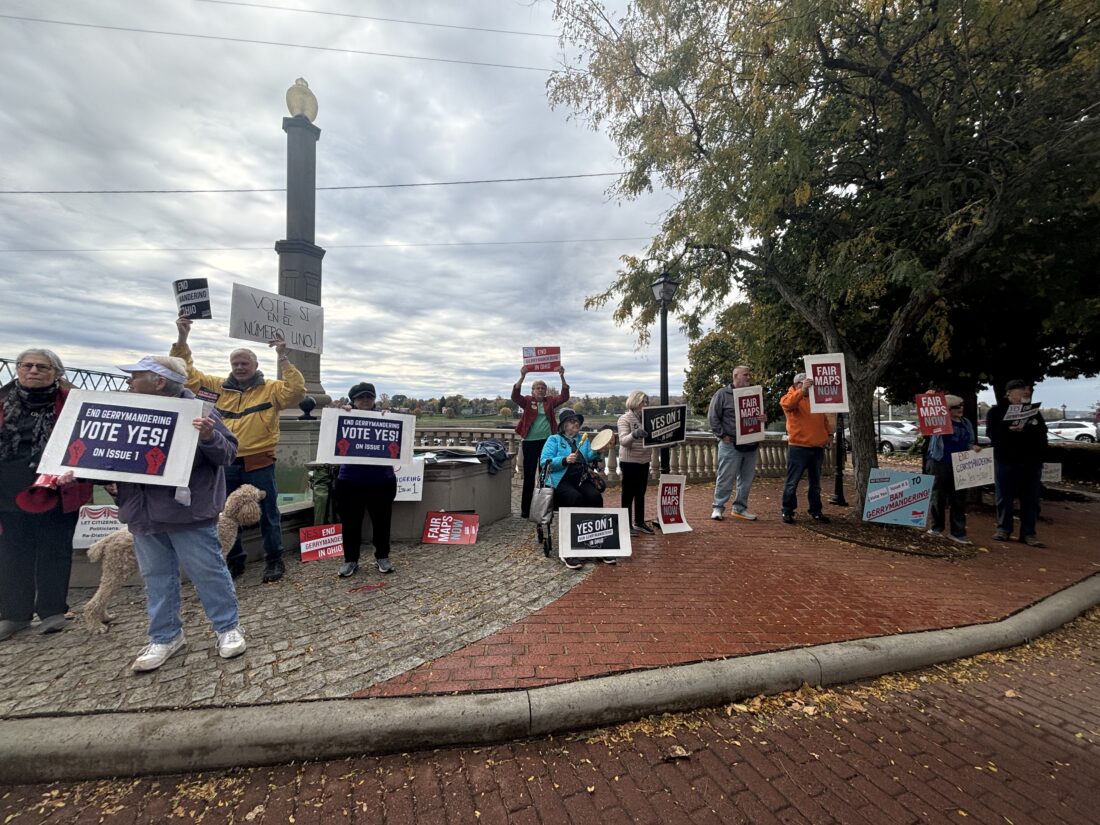
(Photo by Michelle Dillon) Proponents of Issue 1, an Ohio state constitutional amendment voters will decide in November during the general election that would create a redistricting commission made up of citizens, not politicians, gather at the fountain in Bicentennial Plaza in Marietta Friday afternoon to show their support.
A small group of people with signs gathered together in Marietta Friday to express their support for Issue 1, an amendment to the Ohio State constitution that would create a redistricting commission made up of citizens, not politicians, who would be the ones to draw state legislative and congressional districts.
People holding signs displaying slogans like “End Gerrymandering. Vote Yes! On Issue 1” and “Fair Maps Now” and even one person holding a drum, gathered in front of the fountain in Bicentennial Plaza in Marietta Friday afternoon to express their support for Issue 1.
Ohio voters will vote yes or no on Issue 1, also known as the Citizens Not Politicians amendment, in less than two weeks during the Nov. 5 general election.
According to a copy of the amendment on Citizens Not Politicians’ website – who is the group behind the amendment – it would create a redistricting commission made up of 15 Ohio citizens, five Democrats, five Republicans and five independents.
The amendment says members of the redistricting commission would be picked by a screening panel made up of four retired judges – two Democrata and two Republicans – and the panel would be chosen by the four members of the Ohio Ballot board.
According to the amendment, the Republican ballot board members would pick the Democrats for the panel and the Democrat ballot board members would pick the Republicans for the panel.
The panel would use a professional search firm to help them pick a pool of 90 qualified applicants for the redistricting commission made up of equal numbers of Democrats, Republicans and independents, the amendment said.
The panel would give a chance for public comment and conduct interview and select 45 finalists – 15 Republicans, 15 Democrats and 15 independents – that would collectively form a geographically and demographically representative cross-section of Ohio and then randomly draw six of the commissioners who would be equally divided among Democrats, Republicans and independents, according to the amendment.
Then those six commissioners would select the nine remaining commissioners – three Democrats, three Republicans and three independents – by a majority vote, the amendment said.
Those not eligible to be on the commission or panel includeL current elected or appointed federal, state or local officials or their immediate family members or any that had been one in the current year and preceding six years and their immediate family members; candidates for these federal, state or local office in the current year or preceding six years or their family members; paid consultants, staff members or contractors of any elected official or candidate in the current year or preceding six years or their immediate family members; and registered lobbyists or legislative agents of the state of Ohio or the federal government in the current or preceding six years or their immediate family members.
Members of the commission would not be able to hold elected or appointment state offices in Ohio for the six years following the certification of any redistricting plan either, the amendment said.
Commissioners would be removed by other members of the commission for cause, using a public hearing and giving an opportunity for public comment, according to the amendment.
There are many supporters and opponents of Issue 1. One supporter is Democrat Wenda Sheard, who is running for state representative for the Ohio 94th district.
“I urge voters to vote yes on Issue 1, despite the misleading language on their ballots,” Sheard said in a written statement.
One reason people should vote yes for issue 1 is because the maps drawn through the current redistricting process have been declared unconstitutional seven times, according to Sheard.
“The current process hugely lacks accountability,” she said.
The amendment has accountability built into it because the citizens that would make up the redistricting commission could be removed for cause and their decisions would be appealable to the Ohio Supreme Court, Sheard said.
Another reason to support the amendment, according to Sheard, is cost.
“Issue 1 will cost much less than the millions of taxpayer dollars spent on out-of-state lawyers to defend maps drawn by politicians,” she said. “The citizen commissioners will be paid $125 per day and only for the days they work.”
People should vote yes for Issue 1 because the current process excludes citizens from serving on the commission except for seven people who are politicians, according to Sheard.
These politicians have “a stake in the outcome,” she said. “Issue 1 will allow millions of Ohioans the possibility of serving on the commission of 15 citizens, none of whom are politicians or lobbyists wanting to rig the maps in their favor.”
Washington County Commissioner Kevin Ritter, Sheard’s opponent in the state representative race, is an opponent of Issue 1.
One reason he believes people should vote no on Issue 1 is a lack of accountability.
“The system as it exists now calls for a seven person panel,” Ritter said. “Each of those (commissioners) is an elected official.:”
He said this means they are accountable to voters and the panel is bi-partisan by law. He also said the current commission voted unanimously for the new maps now in place.
Ritter also pointed out that the citizens that would be on the commission would be appointed not elected and this gives no recourse to remove them, as the only way they would be able to be removed is by other members of the committee.
Another reason people should vote not for Issue 1 is cost, according to Ritter. He said the redistricting commission would have an unlimited budget and the amendment gives them the freedom to spend what they think the job requires.
He also said there needs to be accountability on spending and he doesn’t think “anybody should have an unlimited budget.”
Another reason to vote no on Issue 1, according to Ritter, is the size of possible new districts. He said Issue 1 would pull areas out of urban districts and pair them with mostly rural areas for new districts and this would violate the principles of districts being roughly the same size.
The text of the amendment can be found on ballotpedia.org.
Local News
City provides $10,000 to the Blennerhassett Historical Foundation to promote museum, island
State Tax Department wants say in federal case over Justice-owned Greenbrier Resort
CHARLESTON - In the latest twist and turn surrounding the fight over the historic Greenbrier Resort between U.S. ...
Washington County Family and Children First announce launch of community-wide partnership ‘No Wrong Door’

WVU President speaks at 57th annual Kootaga District Leadership Dinner
Local events
Meetings ¯ The Belpre City School District will meet at 5 p.m. today at the Stone Administration/Early Learning ...
Music in the Park schedule announced
Artsbridge has announced the 2026 schedule for the Music in the Park Summer Music Series. Shows are held from ...