Speaking out: Public meeting held in regard to injection wells
Public meeting held in regard to injection wells
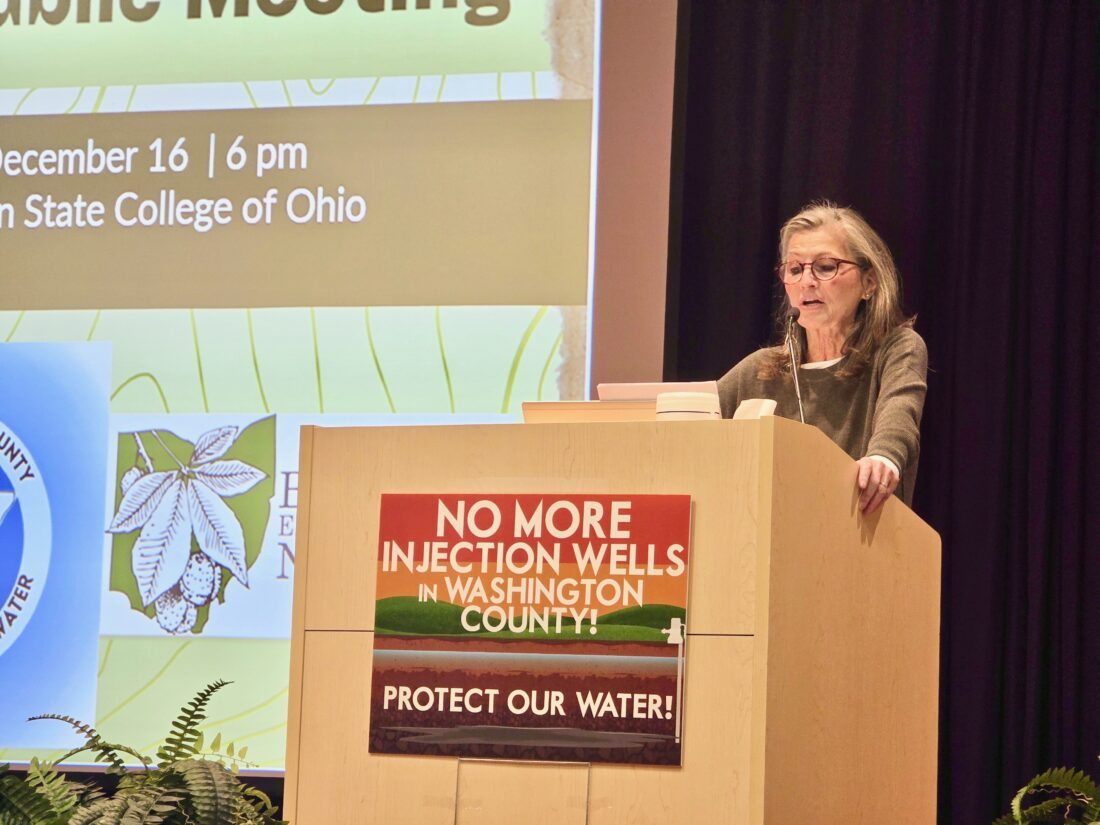
Dee Wells Arnold welcomes the crowd to the Injection Well Public Meeting at Washington State College of Ohio, Tuesday evening. Speakers included representatives from Washington County for Safe Drinking Water sharing their concerns regarding injection wells. The evening also featured an overview of Buckeye Environmental Network’s legal challenge against ODNR. (Photo by Gwen Sour)
Washington County for Safe Drinking Water hosted a public forum Tuesday evening at Washington State College of Ohio focused on oil-and-gas wastewater injection wells and their proximity to local drinking water sources in Washington County.
The event brought together scientists, journalists, environmental researchers and several hundred residents to discuss how injection wells operate, how they are regulated in Ohio and what organizers and speakers said are potential risks associated with underground disposal of oil-and-gas waste.
Dee Wells Arnold, speaking on behalf of Washington County for Safe Drinking Water, said the group formed in 2025 in response to injection wells located near municipal water supplies serving Marietta and Williamstown.
“I have become deeply concerned about the explosion of injection wells that have occurred in Ohio and specifically in Washington County,” Arnold said.
Arnold said Washington County has more Class II injection wells than the entire state of Pennsylvania and ranks second among Ohio’s 88 counties for the volume of oil-and-gas brine injected underground. She said 2.8 billion gallons of radioactive oil-and-gas waste have been injected into the county over a 10-year period.
Jessica Archer followed with an overview of injection wells and the composition of oil and gas wastewater. Archer said the wastewater, commonly referred to as brine, contains high levels of salt, heavy metals, chemical additives and naturally occurring radioactive material.
Archer cited a Pennsylvania wastewater study that found brine samples averaging 8,344 picocuries per liter of radium, with some samples measuring as high as 28,500 picocuries per liter. The federal drinking-water standard for radium is 5 picocuries per liter.
Archer said Ohio has more than 240 active injection wells and continues to accept oil and gas waste from other states. She also said injection wells in Ohio are regulated by the Ohio Department of Natural Resources rather than the state agency responsible for enforcing the Safe Drinking Water Act.
During her presentation, Archer described past incidents in Southeast Ohio where ODNR determined injected brine migrated into nearby production wells, including cases in Noble, Athens and Washington counties. She also said ODNR permitted certain wells near Marietta using older rules, despite updated injection-well regulations taking effect in 2022.
Dr. John Stolz, a professor of biological sciences at Duquesne University, spoke about the scientific uncertainty surrounding underground disposal of oil-and-gas waste. Stolz said injection wells rely on the assumption that waste will remain confined in deep rock formations, but he cautioned that geological systems are not perfectly sealed.
“All rocks are permeable to some degree,” Stolz said. “The idea that any rock layer could seal off waste is simply wrong.”
Stolz also discussed the role of injection pressure and volume, saying failures often occur when operators attempt to inject large amounts of waste at high pressures, which can stress well integrity and surrounding formations. He referenced studies regarding induced seismicity associated with injection wells, including earthquakes in Oklahoma and the 2011 Youngstown earthquakes that researchers linked to injection activity.
Investigative journalist Justin Nobel presented historical research showing that concerns about injection wells have existed for decades within industry and government. Nobel said early federal documents described injection as a temporary solution rather than a permanent disposal method.
“We really do not know what happens to the waste down there,” Nobel said, quoting from a 1970s federal conference on underground waste management.
Nobel also said documents from the U.S. Geological Survey and Environmental Protection Agency warned that injected waste could migrate through rock formations and reappear in wells, springs or other underground pathways over time.
“The consistent theme is uncertainty,” Nobel said.
Dr. Ted Auch, a researcher with Field Notes and former analyst with FracTracker Alliance, focused on oil-and-gas waste transport and data tracking. Auch said Ohio receives large volumes of brine by truck, often from out of state, and said inconsistencies between waste reports in neighboring states and Ohio’s injection data make it difficult to fully account for disposal volumes.
“There are huge data inconsistencies,” Auch said.
Auch also discussed estimates used to determine how much waste Ohio’s sandstone formations can absorb, saying those estimates were based on limited information and broad assumptions.
“These capacity numbers were educated guesses at best,” Auch said.
The forum included video testimony from residents who described changes at domestic and production wells near injection sites. Several residents said wells that previously produced oil or gas later began producing water, which they believe is connected to nearby injection activity.
Bev Reed with the Buckeye Environmental Network outlined a lawsuit filed against ODNR challenging the permitting of two Class II injection wells near Marietta. Reid said the lawsuit alleges ODNR relied on outdated rules and applied a smaller area of review than required under newer regulations, leaving many nearby wells out of corrective-action analysis.
During a question-and-answer session, audience members asked about drinking-water testing and health impacts. An organizer said Marietta’s most recent test for radioactive contaminants, conducted in June 2025, resulted in no detection.
Panelists said they were not aware of studies directly linking injection wells to cancer clusters and said research on injection-well impacts is limited.
Organizers circulated a petition supporting a moratorium on new injection wells, which was approved unanimously by Marietta City Council and several local water boards.
The group said additional questions submitted by attendees would be addressed at a later date.
Gwen Sour can be reached at gsour@newsandsentinel.com
Terms to know:
* Brine – Brine is salt water that comes to the surface during oil and natural gas production. It often contains dissolved solids, metals and naturally occurring radioactive materials. Because it cannot be reused safely, it is typically disposed of through underground injection. (Source: U.S. Environmental Protection Agency)
* Class II Injection Wells – Class II wells are federally regulated under the Safe Drinking Water Act and are used only for fluids associated with oil and gas production. They dispose of brine and other liquid waste by injecting it deep underground into porous rock formations, sealed off from groundwater by layers of rock and casing. More than 180,000 Class II wells operate nationwide. (Sources: U.S. EPA, Ohio Environmental Protection Agency)
* Class I Injection Wells – Class I wells are used for non-hazardous and hazardous industrial and municipal waste. They inject waste thousands of feet below drinking water aquifers into isolated rock formations. These wells are subject to stricter siting, construction, monitoring and testing requirements than Class II wells. (Sources: U.S. EPA, Ohio EPA)
Local News
Belpre holiday events rescheduled
BELPRE — Several activities originally scheduled for last Saturday but cancelled due to inclement weather have ...

Get creative this winter at the Parkersburg Art Center
Road closure for sewer tap installation
Front Street from Washington to St. Clair Street and the westbound lane of Washington Street between Second and ...

Bond denied for murder suspect in Parkersburg shooting
Vincent man arrested for child pornography charge