
Remembering Rinard Mills
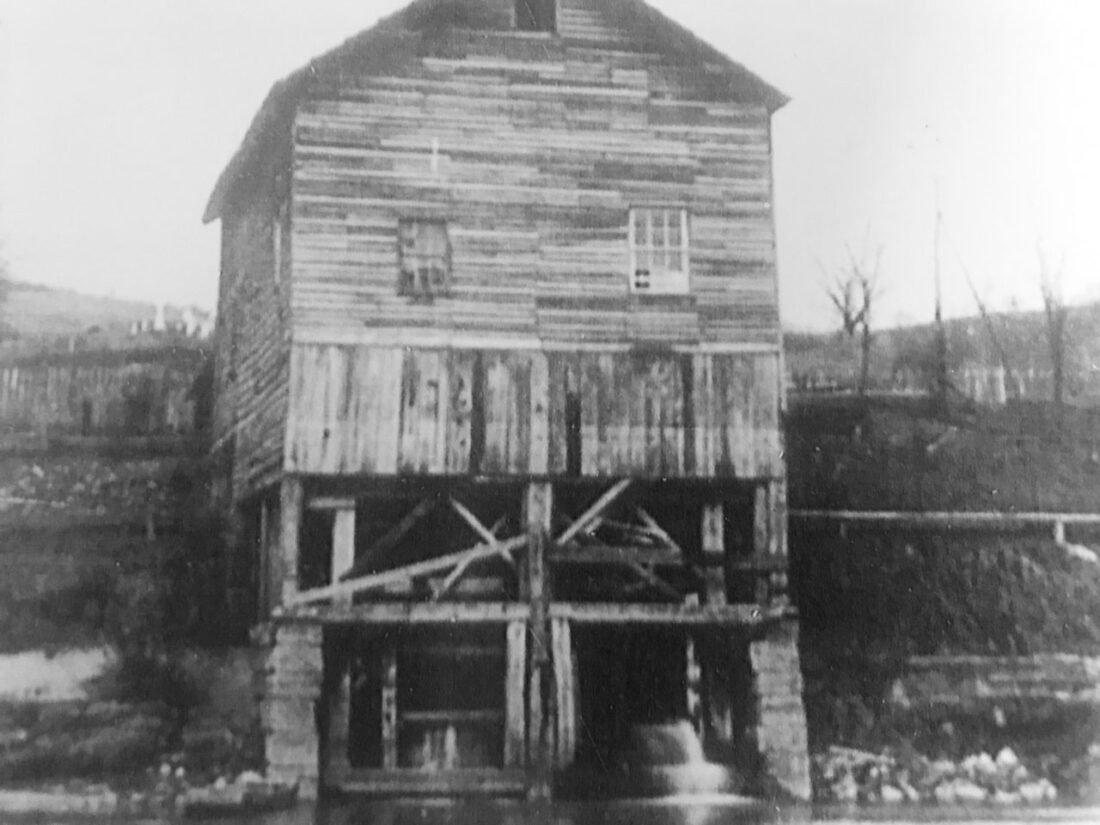
This picture shows the original mill of Isaac Rinard along the Little Muskingum River at Rinard’s Mill. (Photo Provided by Matamoras Area Historical Society)
The final stop on our swing through the terrain that surrounds Matamoras is Rinard Mills. A very small community just over the border of Washington County when traveling north on Ohio State Route 26.
The spot holds a special place for me because one mile past Rinard Mills, still going north on the same state route, is the old Riggs/McCaslin farm where my mother, Carol, and her older sister, Beryl, were born to Frank and Lucy Riggs McCaslin.
Credit for much of this subject goes to the work of Norma Jean Dye Antill, who counts Rinard Mills as a much favored location as well.
Isaac Rinard, who was the namesake for the little settlement, was born to German heritage in 1770 in eastern Pennsylvania. When he turned 15 he was apprenticed to learn the trade of a tanner. After five years he determined this was not the skill that would define his life and so started westward to find his livelihood..
He lived for about a decade on his skill of hunting the game found plentifully in the Allegheny wilderness. And eventually married Mary Young. To this union two children were born. First was Sarah and then John. But the mother died soon after the birth of her son. After a few years had passed Isaac wed Ester Elder who would bear him eight more children.
During the war with the Native Americans, Isaac fought under Anthony Wayne. He was in a scouting party that opened the way for the main body of troops and was engaged in a number of encounters with their opponents.
When his service was over, his attention turned to milling. About 1813 he loaded the family’s possessions, including his flint mill burs, on a raft and floated down the Allegheny and Ohio Rivers to eventually settle on a site at Leith Run. He was there for six years milling wheat, rye and buckwheat flour.
He sold out to John Rea and moved north along the Ohio to settle on Mill Creek, a short distance above Matamoras.
He stayed there until circa 1830 to then build a mill on the Little Muskingum River where Rinard’s Mill would be established. The same flint mill burs were taken by Isacc to all three of these sites.
Isaac died from blood poisoning in the fall of 1865 and was buried in what is now the Rinard Mills Cemetery.
Next week the longest lasting enterprise of the hamlet will be presented.
John Miller is president of the Matamoras Area Historical Society. Membership dues are $15 per year single/couple. Life membership is $150. Contact the society at P.O. Box 1846, New Matamoras, Ohio 45767. Much of this column is built on the work of Matamoras’ historian, the late Diana McMahan.