Know Before You Grow: Container Craze!
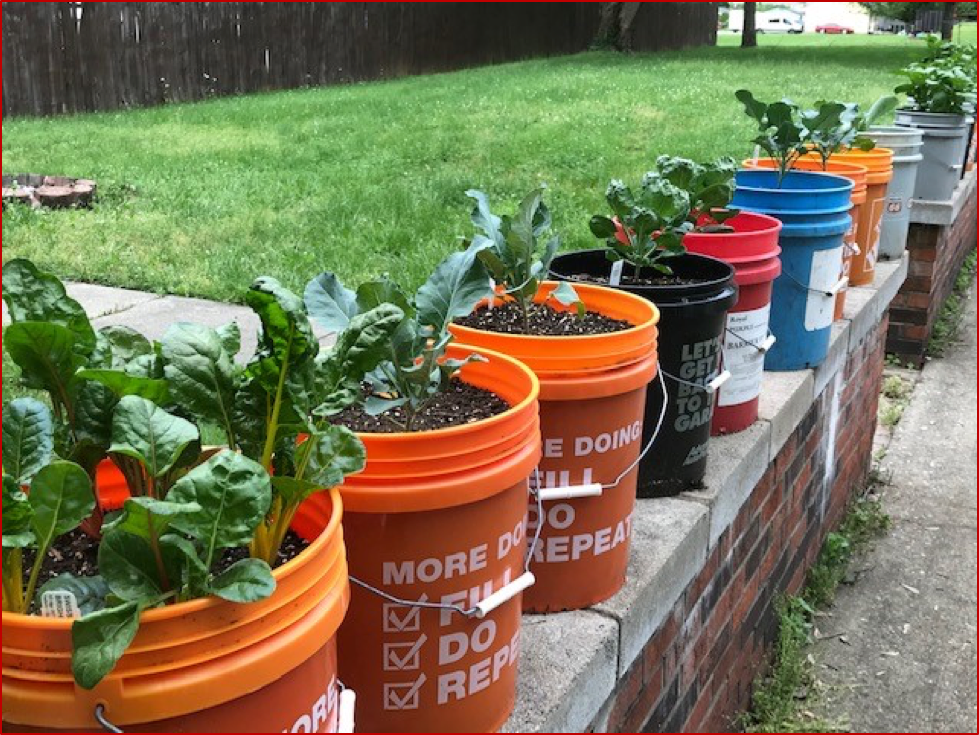
(Photo provide) Container gardening: Swiss chard, broccoli, kale, and peppers
Do you love plants but do not have the time or space for a garden?
Then container gardening may be a great fit for you to meet your plant loving needs.
Containers are a great way to grow plants where there is no access to the soil (example: windowsill, patio, balcony, or doorstep) or no space for a garden.
They also add attractiveness and liveliness to dull areas like patios, are great for people with disabilities or mobility problems, and generally low input, saving time.
To make your container garden vision a reality, all you need are just six items: plants, container, soil medium, light, water, and nutrients
Containers:
When it comes to selecting a container for your plant, you are only limited by your imagination.
Almost anything can be use as a container as long as it holds soil and has drainage holes. Containers can be made from: clay, wood, plastic, fiber, and metal.
They can also be made from old used items or things laying around your home like buckets, trash cans, crates, milk cartons, barrels, window boxes, lined baskets, tires, hay bales, cinder blocks, drainage pipe, old boots, etc.
Whatever you choose, the container should be big enough to support plants when they are fully grown, and never have held products that would be toxic to plants or people if they cannot be properly cleaned.
The common mistake for new container gardeners is underestimating the size of the container needed to sustain mature plants. For any given plant, the larger the container, the greater the number of plants which can be grown. For recommendations of pot size, contact the OSU Extension office (ex: tomato and cucumbers pots should be 4-5 gallons).
Water:
Plants growing in containers dry out much faster than when grown in the ground. Monitoring the soil moisture is a must. Small pots tend to dry out more quickly than larger ones.
During hot summer days, daily or even twice-daily watering may be necessary. Avoid letting your containers dry out for too long.
Plants can become quite stressed from prolonged periods without water. Water should be added when you feel no moisture below the soil to the touch. Mornings are the best time for watering. Water the entire area and apply until it runs out the drainage holes and remember to avoid excess watering — it can be fatal.
Soil Medium:
Potting soil is recommended for container gardening. It is lightweight and porous, allowing for air and water movement and root growth. Use commercial potting mix composed of sphagnum peat moss and perlite. Perlite is a sterile white material produced by super heating volcanic rock until it pops. Due to being very lightweight and porous, it’s used to help improve air flow and drainage. Garden soil should not be used in containers. FUN FACT – there is no soil in potting soil. It is a sterile soil-less medium.
Nutrients:
Since potting soils are sterile, it lacks nutrients. Some potting soils contain fertilizers, compost, or other organic material.
However, at some point nutrients (fertilizer) must be added. These products easily available and can be found at your favorite garden center. There are slow-release fertilizer pellets (at planting) and water-soluble fertilizer (used as plants grow). When applying, follow the directions according to the package.
Light:
Most vegetables and annual flowers need full sun, and some flowering plants prefer shade, so locate your containers appropriately to simulate the plant’s natural environment.
For plants requiring full sun, place your container(s) in areas which receive at least six to ten hours of direct light. Partial sun is between four and six hours of sun per day, partial shade is two to four hours of sun per day, and shade is less than two hours of sunlight a day.
If you have more questions and would like to learn more about container gardening, then Greenleaf’s Container Craze program may be just for you.
OSU Extension and Greenleaf will be offering a container gardening workshop this Sunday at 4:00pm. Please contact Greenleaf for more information: 740-373-1639.
About the Author:
Marcus McCartney is the OSU Extension Agriculture and Natural Resources Educator for Washington County. He has been with extension since 2014. Marcus received both his bachelor’s and master’s degrees from West Virginia University.
Local Columns
Cracking the Code: Are you weak enough?
The hardest person to teach is the one who knows everything, or thinks they do. One of the most important lunches ...
MOV Climate Corner: Grateful for community support
Mid-Ohio Valley Climate Action (MOVCA) was proud to take part for the first time this year in the Parkersburg Area ...
The Way I See It: Cabooses met their end in the 1980s
Backyard Gardener: Mexican sunflower for pollinators
Hello Mid-Ohio Valley gardeners and farmers! I am thankful we received some much-needed rain here in the valley. ...
Cracking the Code: Data centers
On Monday, one candidate for West Virginia House of Delegates stood on a street corner holding up his campaign ...