
Drug treatment court officials answer public’s questions

Washington County Common Pleas Court Judge Mark Kerenyi speaks to a gathering of about 50 people Wednesday night about the coming launch of the drug treatment court, a system that helps divert drug offenders to treatment programs rather than prison. (Photo by Michael Kelly)
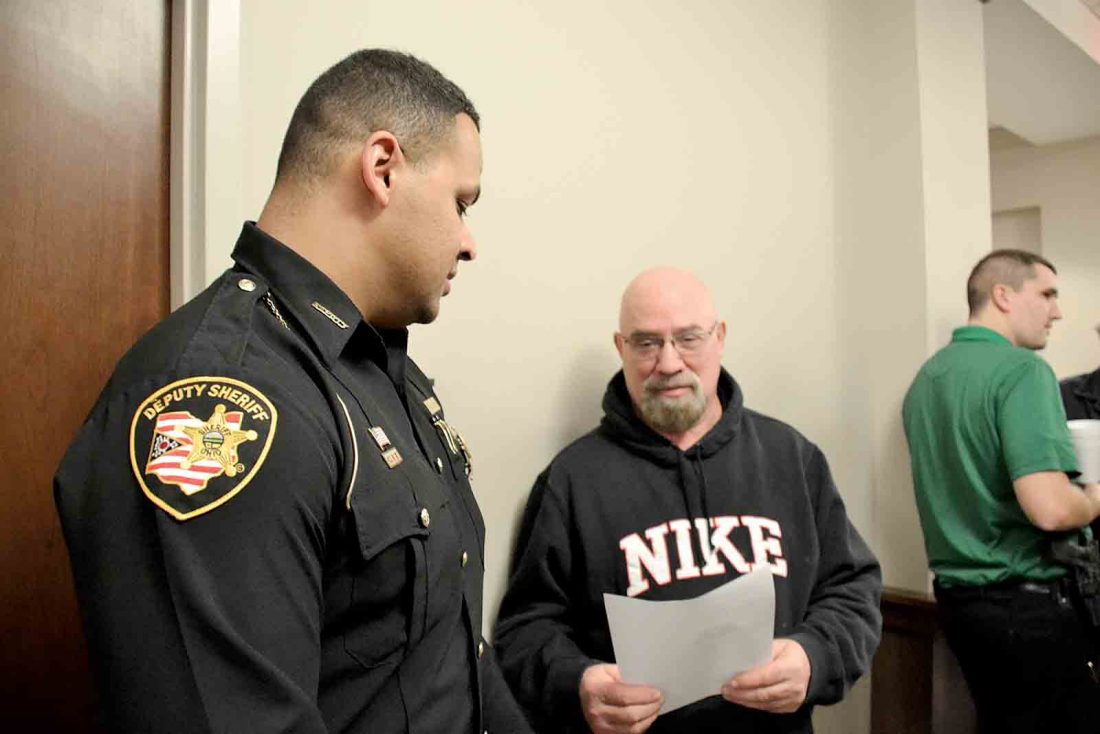
Washington County Sheriff’s Deputy Chris Jones talks to Dave Pannell of Vincent in the hallway outside the Marietta Municipal Court after a public meeting about the county common pleas drug treatment diversion program Wednesday night. (Photo by Michael Kelly)
Washington County Common Pleas Court Judge Mark Kerenyi speaks to a gathering of about 50 people Wednesday night about the coming launch of the drug treatment court, a system that helps divert drug offenders to treatment programs rather than prison. (Photo by Michael Kelly)
Washington County Sheriff’s Deputy Chris Jones talks to Dave Pannell of Vincent in the hallway outside the Marietta Municipal Court after a public meeting about the county common pleas drug treatment diversion program Wednesday night. (Photo by Michael Kelly)
Trending
A new era in the Washington County justice system is less than two weeks away from becoming reality, and Wednesday night a public meeting was held to answer questions and offer information about it.
The drug treatment court, a system already being used in Athens and Hocking counties and other jurisdictions scattered around the nation, is tentatively scheduled to hear its first case Jan. 28, Washington County Common Pleas Court Judge Mark Kerenyi told the group of about 50 people gathered in the second-floor courtroom of Marietta Municipal Court.
The court essentially offers drug possession offenders who qualify the option of enrolling in a treatment program rather than going to jail.
"It's voluntary, but of course the other option is serving jail time," Kerenyi said. The program is funded through grants, approximately $300,000, and expected to be cost-neutral for the county.
To function effectively, the program requires the cooperation of agencies that include the court, law enforcement agencies and three treatment providers - Oriana House, L&P Services and Hopewell Health, all of which provide an array of services for people and families with substance use disorder problems.
A key element in the program is the Quick Response Team, led by Washington County Sheriff's Deputy Chris Jones, who spoke to the meeting about his role.
The QRT is intended as a preventive initiative, set up to make contact with people who have substance abuse problems before they run athwart of the law, or at least in the early stages of that contact. Jones said that in the starting period of the team's operations, there will be a lot to overcome.
"Basically, we're building a system to receive referrals," he said. "We try to build a rapport with the person, make some home visits, develop mutual trust. When I come in contact with them, through information I get from anyone, it might be the Marietta or Belpre police department, I'll go there, sit down at the kitchen table with them, talk to them."
Jones said the goal is to get willing people into treatment before they become entangled in the court system, but most people in that situation also are wary of contact with police.
"I try to stay active on the drug and warrants side of things, so I'm often the one who runs into them the first time," he said. "I might sit down with them right then and there and talk to them about this program. We'll exchange phone numbers. But it's really difficult for somebody who goes to jail every time they see a cop."
For referrals, he said, "I'll go there in a polo shirt and jeans, no badge, no gun. It's less threatening that way," he said. The next step could be contact with someone like Ashley Sprouse of Hopewell Health's Belpre Center.
"They often don't want to talk to the police, and that's where we come in," she said. "I can go there with bags of information about meetings of support groups, lists of facilities, I can provide them with information and they can choose. This program also lets us get to know people and opens our eyes to other things happening in the community, where the individuals are who need help the most."
An outreach program of that kind is a new area for law enforcement, but Jones said a robust system has been up and running in Athens and Hocking counties for some time.
"I spent a day there," Jones said. "They had referrals coming in while we were making calls. There were six referrals waiting when they got back."
Kerenyi said the program now is funded for 30 people and expects five to 10 at the beginning. The ultimate size of the program will depend on the grants Oriana House is able to secure, he said.
Municipal Court Judge Janet Dyar Welch, who hosted the gathering, said the work of the Quick Response Team is crucial to the overall goal of diverting those who need treatment rather than incarceration.
"By the time you see Kerenyi or me, you're late in the process," she said. "The Quick Response Team is new in Washington County, and I cannot overstate its importance."
Representatives of several support groups spoke, conveying the sense of hope available by associating with those who have been through the addiction experience and are now experiencing sobriety.
Janice McFarland, a case manager for L&P Services, emphasized the value of peer counseling, especially for families of people with substance abuse disorders.
"If you want to learn, someone with that lived experience can provide you with more than I ever could," she said. "The fellowship is the most important part, but parents and families of addicts can feel isolated, so get with other people who are having the same experience you are."
David Browne, executive director of the Washington County Behavioral Health Board, said after the meeting that the entire system involves many new initiatives, and the county is still learning.
"This really just started in June, so it's come a long way very quickly," he said. "This is really the community owning up to the issue, and things are just going to get better."
Outside the courtroom after the meeting, Vincent resident Dave Pannell, who said he has an addicted person in his family, stood talking to Deputy Jones.
"This evening has been really good, things seem to be set up," he said. "This is a lot of help for parents. We're the ones who haven't given up on our kids."