
Marietta College to celebrate planetarium upgrade
Trending
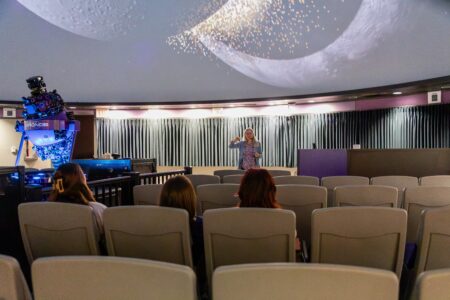
Marietta College on Saturday will celebrate the reopening of the upgraded Anderson Hancock Planetarium.
A Marietta Area Chamber of Commerce ribbon cutting ceremony and community open house will take place from 10 a.m. to 4 p.m. The event is free and open to the public.
The project was made possible through a U.S. Department of Agriculture Community Facilities grant, institutional investment from the college and contributions from more than 100 alumni and donors. That includes a significant lead gift from Carole Wylie Hancock through the estate of her late husband, Professor Emeritus Whit Hancock.
Constructed nearly 20 years ago, the original planetarium was established through the generosity of Dave and Brenda Rickey in honor of beloved physics professors Les Anderson and Whit Hancock.
"The transformation of the planetarium is a powerful example of partnership in action. We are grateful to the USDA for their Community Facilities grant, and to the alumni and donors who collectively made this project possible through their generosity," said Bethany McFarland Leslie, vice president for advancement. "The college was equally committed, investing alongside these partners to ensure this space continues to inspire curiosity, discovery and learning for generations of students."
The upgrade was completed in March. According to a release form the college, the installation of a new, high-performance digital projection system, Digistar 2026, replaces the planetarium's previous Digistar 3 technology. The new system delivers brighter, sharper and more immersive visuals, with higher resolution, richer color and improved contrast expected to greatly enhance the viewing experience for students and visitors.
The changes can benefit programs beyond astronomy, opening new possibilities for interdisciplinary learning in geology, anatomy and other fields, the release said. With a more user-friendly interface, automated projector alignment and fully integrated system controls, the upgrade transforms how students engage with complex concepts and offers more dynamic learning experiences, it said.
"We are thrilled to officially launch the upgraded Anderson Hancock Planetarium. Returning visitors will immediately notice an increased 'wow' factor, with brighter, more colorful, and higher-resolution imagery on the dome," said Ann Bragg, planetarium director. "Even more exciting is what the upgrade makes possible: an enhanced capacity to present and create cutting-edge educational visualizations for our students and the broader community, supported by a global network of Digistar users sharing high-quality, customizable content."
The planetarium continues to combine its longstanding traditional analog starball projector with a state-of-the-art digital system. This hybrid approach preserves the precision of the traditional starball while expanding the capabilities of full-dome visualization technology, the release said.
Upgrades also included enhancements to the planetarium's supporting technology and infrastructure, including new computing systems, updated lighting and an improved console area.
For students and faculty, the enhanced system creates opportunities for hands-on learning while enabling students to develop and share original content through a global network of software users, the release said. Building on these capabilities, the college plans to expand its planetarium seminar course, where students can operate the system and produce immersive educational programming.
The Anderson Hancock Planetarium regularly offers free public shows and hosts school field trips, scout groups and other community visits.
Following the ribbon cutting, visitors are invited to view programs that showcase the planetarium's new capabilities. Shows will run every 30 minutes until 4 p.m.
The Anderson Hancock Planetarium adjoins the Rickey Science Center at the corner of Fourth and Butler streets. The 4,400-square-foot facility features theater-style seating for 102 guests and is fully accessible for guests with disabilities.
More information is available online at marietta.edu/planetarium or by contacting planetarium@marietta.edu.