
A look at Mill Creek
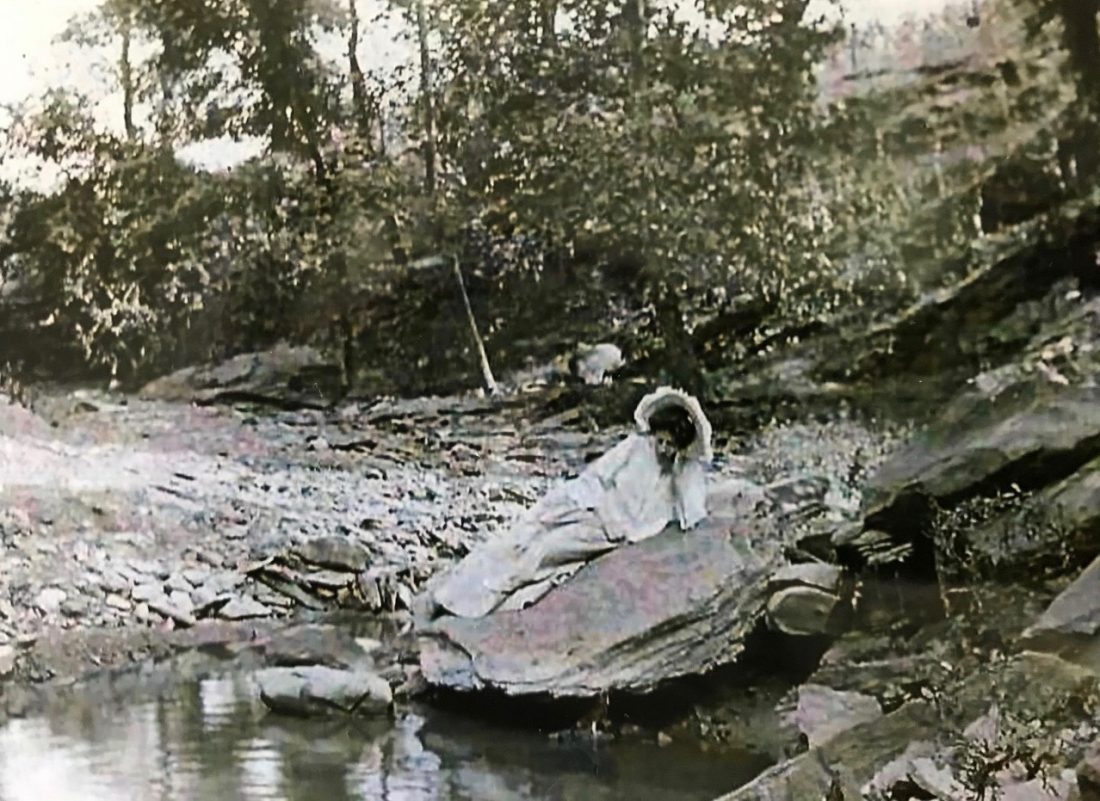
(Photo provided by Jim Moore) This Matamoras beauty of the early century poses for the camera at a location on Mill Creek.
In last week’s column, as well as several other instances, the area upriver from Matamoras called Mill Creek has been mentioned. It flows into the Ohio River opposite an island that lies against the West Virginia shore. This island has been known as Mill Creek or Matamoras Island, and in earlier times as Wilson’s Island. It is appropriate to expound on this settlement. In the initial pre-1800 pioneering of Grandview Township this site was a prominent feature which has since faded into the past.
The creek’s mouth provided the population with its first mill. It also was the location of the first church, first school, and first library — all located in the same log structure. Consolation was provided to those in mourning with early burials for the area.
The community once included a cluster of cabins on both sides of the stream. Today only a single home stands there. The only other modern home was lived in up until the 1950s by Captain and Mrs. Reed and was demolished when State Route 7 was re-routed.
The first recorded mention of Mill Creek is in the Cline, sometimes Klein, History book. George Cline, sometimes spelled Klein, was born in Germany about 1740. He had fought in the American Revolution, and is the first person to have settled there. The year was circa 1795 and he and his family lived on the site for ten years. Cline died in 1801 at the hands of Native Americans and was buried at the spot of his death. A grandson who later died was buried next to his grandfather. Their graves have been lost to the ravages of time.
The first mill was called Buck’s Mill. By 1803 it was in operation with owners John and James Buck as the area’s first millers. Circa 1811 Richard Pool took over the mill. The next owner was Isaac Rinard in the 1820s. He had earlier built a mill in the Leith Run area. After buying the site Rinard completely remodeled the old mill and passed it on about 10 years later to his son, John. During dry summers the creek didn’t furnish water enough to operate the mill full-time. When a rain system passed through, the miller ran it night and day to catch up with the backload.
With time Mill Creek became more of a recreational spot. Swimming and fishing enthusiasts took advantage of the location for their enjoyment.
John Miller is president of the Matamoras Area Historical Society. Membership dues are $15 per year single/couple. Life membership is $150. Contact the society at P.O. Box 1846, New Matamoras, Ohio 45767. Much of this column is built on the work of Matamoras’ historian, the late Diana McMahan.
Local Columns
The Way I See It: Museum has been part of the riverbank for a half century
MOV Climate Corner: Out-of-state interests win, real issues lose
With the primaries now behind us, I can’t say I’m entirely surprised by the outcomes. If West Virginia has ...
Early Marietta: Griffin Greene, a Man in Perpetual Motion
Some gave all. Can we give a little?
December 1967, our family was watching TV when the phone rang. It was Uncle Joe, Dad’s older brother. Mom handed ...
Living Democracy: How the latest Supreme Court ruling on voting has changed the Voting Rights Act
On April 29, 2026, the U.S. Supreme Court struck down Louisiana’s 2024 congressional map as an unconstitutional ...
Cracking the Code: Are you weak enough?
The hardest person to teach is the one who knows everything, or thinks they do. One of the most important lunches ...