
Early Marietta: Griffin Greene, a Man in Perpetual Motion
Trending
What else could a Marietta pioneer possibly accomplish who (a) built a perpetual motion machine, (b) Raised the sunken British frigate FLORA, (c) designed a unique floating water-powered mill in the Ohio River, and (d) helped build the Farmers Castle enclosure at Belpre? A LOT more, as you'll see.
Griffin Greene was born in Warwick, Rhode Island in 1749. In his twenties, he and his cousin Jacob built or inherited an iron forge. It thrived during the Revolutionary War making war materials. He was close to another cousin, General Nathanael Greene, namesake of Marietta’s Greene Street and one of Washington’s most dependable senior officers. Griffin was an engineering genius. Two innovative accomplishments are prime examples.
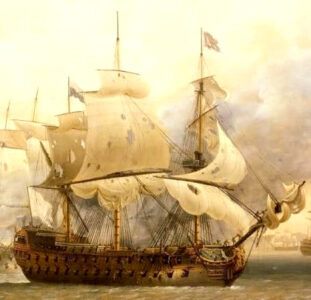
SALVAGING THE FLORA: He invested in a company that salvaged sunken ships during the Revolutionary War. He oversaw the salvage in 1780 of the British frigate FLORA which had been scuttled to keep it from the Americans. The boat was sunk in shallow water near Newport RI harbor. Here was the plan. Step 1 – A diver using a primitive diving bell plugged holes in the hull. Step 2 - Griffin designed and built a huge pump, reportedly inspired by the French Encyclopédie, powered by horses on a flatboat walking in circles. Imagine seeing horses walking in circles on a boat in the ocean. That pump removed an incredible 144,000 gallons per hour. The FLORA was raised in just 6 hours. British loyalists watching nearby “could hardly believe their eyes” as the FLORA emerged. Raising FLORA was a success but operating her for profit was not. Griffin sailed FLORA in 1783-84 to France and sold her at a loss. While in Europe, he observed a floating water-powered mill in Holland. Keep that thought.
FLOATING WATER POWERED MILL. A water powered grist mill was crucial for the early settlers to grind corn and other grains into flour or meal for cooking. Rotary hand mills were slow and very laborious. The floating mill he saw in Holland? That inspired him to design one for use in the Ohio River near Belpre. Jonathan Devol actually built it. Here's the set-up: two flat boats, one larger than the other, are connected by planks of wood. The water wheel is in the middle, powered by the river current. On the larger boat houses the machinery and workers. The smaller boat is merely a pontoon to support the wheel. The whole structure is anchored to shore. The floating mill has advantages compared to a fixed mill on a river or stream bank: it automatically adjusts to the water level, does not require a dam or sluice gates, can be positioned where water flow is optimal. This was the first such mill in America.
In 1788 Griffin Greene moved his family to Marietta seeking new opportunities. Soon he added a new activity to his busy life: government service. He was appointed justice of the peace and judge of the county court. After moving to Belpre, Griffin regularly went to court sessions in Marietta, rowing in a canoe. Later he served as postmaster and customs collector. Not bad for a guy with little formal education.
One unusual Griffin obsession was building a perpetual motion machine. Joseph Barker's Recollections (spelling as written): "Griffin Green,... one of our engenious, interprising,& useful citizens... constructed a Machine of considerable size & expence: it consisted of three Arms about twelve feet long, (weighted) with Lead at each end, & erected Virtically." Hard to visualize. The machine did run "with the steadiness of a nice timepiece" for several hours...but inevitably it quit. The device stopped, but Griffin Greene never did.