
The way I see it: Marietta native landed impossible flight
The Maui miracle
Trending
Robert Schornstheimer climbed into the pilot seat of a Boeing 737 on April 28, 1988, unaware that his routine flight between the Hilo International Airport in Hawaii and Honolulu would end up being the No. 1 news story in the world by the end of the day.
The Marietta native and 1963 graduate of Marietta High School had made the flight hundreds of times and has flown thousands of hours in 737s.
As a pilot for Aloha Airlines, it was his job to ferry people between the islands that make up the state. Most flights were short. The particular aircraft he was flying that day, the Queen Liliuokalani, had taken off and landed 89,680 times and been airborne more than 35,000 hours since being built 19 years before.
Flight 243 carried 90 passengers and five crew members as it reached a flight altitude of 24,000 feet above the Pacific Ocean 20 minutes after takeoff. It was around 26 miles from the central valley of Maui when, with "an incredibly loud" ripping noise, part of the plane tore from the fuselage.
Eighteen feet of the roof of the plane was simply gone. When Schornstheimer turned around to see what had just happened, the door to the cockpit was gone. Blue sky replaced what had been the first class ceiling.
"It was actually almost like being in a dream at that point because it's so unexpected your mind tries to protect you from what's going on," Schornstheimer later told The Maui News. "You're just sort of dazed. I did turn right back around and put my oxygen mask on as I was trained to. I signaled to my co-pilot I was taking control of the airplane."
Being a short flight, the passengers all had their seatbelts on. A flight attendant named Clarabelle Lansing had been standing near the fifth row and was swept out of the plane with the roof. Neither she nor the roof of the plane would ever be found.
Schornstheimer and first officer Madeline Tompkins knew the crisis they were in the middle of and immediately began trying to reach the Kahului Airport on Maui.
"I was just totally focused on having to make it," said Schornstheimer. "I didn't have time to dwell on what would happen if I didn't."
Tompkins declared an emergency and warned the tower they were coming in fast and the nose gear might not work. Thirteen minutes after the accident occurred, the plane made a "normal" landing on Maui, stopping right on the center line of the runway -- as normal of a landing as could be made with an aircraft with no roof carrying 65 injured passengers.
"I can't believe it even stayed together," said Larry Miller, the 29-year-old assistant station manager for Aloha Airlines at the time. "The only thing holding that aircraft together were the floor beams. Everything else was gone. It should not have been able to land."
"It looked like it was going to crash," he told the Maui News. "There was part of it missing. The whole top of the fuselage was gone. . . . I didn't possibly think that this plane could land."
The island was not prepared for such an event.
The community of Kahului is not a big city. It did not have enough ambulances to transport so many people to the hospital, so it turned to rental car shuttle vans.
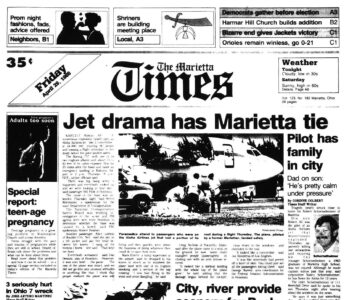
In Marietta, we scrambled to cover the story of the hometown hero, which is how I found myself at the front door of his parents’ house in North Hills. They of course had a photo, taken at a family dinner at the old Point of View restaurant. They handed me the print, and I returned to get it in the paper that day alongside the photo of him helping passengers from the plane that he had somehow managed to land.
"When we talked to him last night, he was still feeling pretty calm," said dad Robert Schornstheimer Sr. to The Times that morning. "He said it just happens and you do what you need to do. He was fortunate he was able to bring it in and land."
The Times later did a special section to celebrate the remarkable landing.
The plane was damaged beyond any chance of repair. After the investigations were over, it was cut up to be recycled. It was later determined that the number of flight cycles the plane had gone through had caused a crack along a line of rivets. Two other planes used by the airline were also taken out of service.
Schornstheimer retired in 2005.
Art Smith is online manager for The Marietta Times and the Parkersburg News and Sentinel. He can be reached at asmith@mariettatimes.com