
What I learned about Johnny Appleseed and his Marietta connections
Trending
John Chapman (1774-1845), AKA Johnny Appleseed, was the eccentric Massachusetts native who planted apple tree orchards from western Pennsylvania to northern Ohio and Indiana. I found that reliable facts about him are sparse; legends and tall tales abound. Author David McCullough: "Much written ...about Johnny Appleseed...has little or no bearing on the truth." There is good evidence, though, that he spent time in Washington County, Ohio.
John Chapman had probably heard of Marietta from his stepmother's cousins, the Cooleys. They had settled here in the 1790’s. John's father Nathaniel Sr. and family moved to Washington County in 1805. They lived near present-day Dexter City, Ohio. John passed through often. Author William Kerrigan noted that he "visited his family regularly," citing sources such as a tavern owner's diary noting his passage through Lowell on annual trips and a lady in Dexter City who recalled John's trips "up and down Duck Creek...". He often visited his brother Nathaniel Jr., though his wife Ammorillah made John wash up in the creek before entering the house.
W. M. Glines, a Marietta resident, said that at age 21 John "received a kick from a horse that fractured his skull...From that time forth he manifested that particular character attributed to him"- referring to the eccentric, unkempt, hermit-like stereotype image. Hard to verify this story.
Other aspects of Johnny Appleseed's life and character that I learned:
STORYTELLER: John Chapman often told tall tales about life threatening events. Children were spellbound listening to him. One example: he's in a canoe on a river choked with ice floes. The ice was moving as fast as he could paddle, so he dragged his canoe on to one of the floes and floated paddle-free. He fell asleep and ended up 100 miles past his intended destination. Tall tale indeed.
ORCHARDS WERE A BUSINESS FOR HIM. I always thought of Johnny Appleseed as a wandering hippie who planted apple trees for other people. Wrong. Orchards were a serious business for him. He planted in areas of future settlement. He scouted for good locations, planted seeds, periodically tended the trees, then sold the land or trees years later when settlers arrived. He owned or leased several hundred acres of land during his life. Author Kerrigan: "John Chapman did not die a wealthy man, but neither was he impoverished…"
APPLES WERE A CRITICAL RESOURCE FOR EARLY SETTLERS. Foxweather.com article: "At the time, apples were more than just a sweet, healthy treat. Rather, they were a versatile fruit that helped people survive…" Orchards were a vital community asset, often the primary source of Vitamin C. Apples provided apple cider, apple butter, and vinegar. Dried apples were stored for eating during winter.
DEDICATED PREACHER. He was a missionary of the New Church which followed the teachings of Emanuel Swedenborg. He preached "Good news fresh from heaven" to anyone who would listen. He avoided harming animals or any of God's creatures in keeping with that faith. Once a rattlesnake bit him. He reflexively killed it but soon regretted his "ungodly" action.
POWER OF ORATORY. He was surprisingly well spoken for such an unkempt person. Rosella Rice, who knew Chapman: "On the subject of apples he was very charmingly enthusiastic ...His description was poetical, the language remarkably well-chosen..." His oratory could be just as impressive when he talked about his faith.
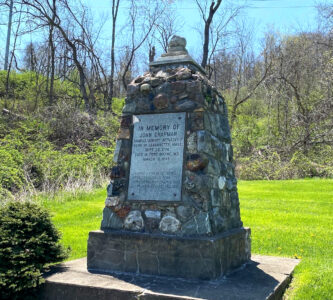
There is a monument to Johnny Appleseed near Dexter City, close to the homestead where his family settled in 1805. It includes this message: "Without a hope of recompense, without a thought of pride, John Chapman planted apple trees and preached, and lived and died."