Thompson civil suit testimony enters second week
AEP accused in woman’s death by smoke inhalation
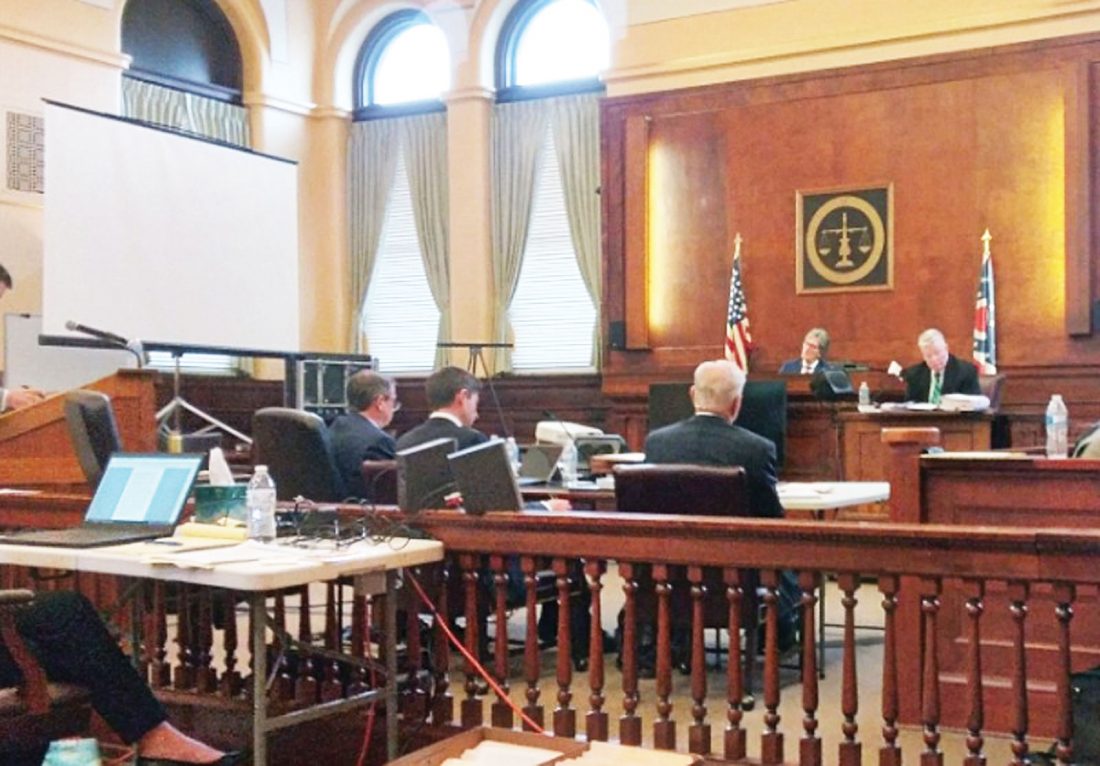
Dr. Edmund Donoghue, a forensic pathologist, testified Monday as to the results of Elsa Thompson’s autopsy after she died in a house fire in March 2019. (Photo by Michele Newbanks)
Eight people took the stand Monday to start the second week of testimony in a wrongful death suit over a May 2019 house fire that killed a Marietta woman.
Defense witnesses begin testifying at 9 a.m. today.
The suit, filed in 2019 against American Electric Power, claims downed power lines after a storm weren’t fixed in a timely manner, causing 85-year-old Elsa Thompson’s Warren Street home to catch fire. Thompson died of smoke inhalation as a result.
Elsa’s daughter, Laura Thompson, took the stand at the end of the day. She spoke mostly about the effect her mother had on their family, with her sense of humor and love of tradition.
“She was passionate about keeping family close,” Laura said. “I wanted to be just like her when I grew up. I think for all of us, she was our touchstone.”
Elsa was also passionate about birds, leading her and her husband, Bill, to start Bird Watcher’s Digest in 1978.
Laura said the fire happened on Memorial Day weekend in 2019 and she was out of town for a graduation. Originally, Elsa was to go, but they only had a few tickets. After celebrating that night, she was awakened to the news her mother’s house was on fire.
She talked to her brother, the late Andy Thompson, who was at the scene of the fire and learned her mother had died.
“We were in shock. There weren’t words to make it real for any of us,” Laura said.
Laura testified she is still struggling from the loss of her family. Her brother, Bill, died two months before Elsa, while her brother Andy died about a year later.
“I don’t have the energy I had. I find it difficult to concentrate,” she said. “I have a lot of nightmares.”
Three of Elsa’s grandchildren, Nathaniel, Liam and Phoebe Thompson, also testified.
Nathaniel, the son of Jade Thompson and the late Andy Thompson, said he misses his grandmother and wishes Elsa and his girlfriend could meet. He also spoke of how his father dealt with the death of his mother so soon after his brother passed.
“He was under an extreme amount of stress,” Nathaniel said. “He had to step up and get a lot of things done for the family. I was there with him when they tore the house down and you had to watch all your memories torn down in front of your face.”
Liam said recalled seeing the burned-out house and “the bones of the gathering place in the home.
“It was all charred and blackened. There was a smell to it,” he said. “It was something that shook me to the core.”
Phoebe was living in the Canary Islands at the time and couldn’t afford to come home for Elsa’s funeral. She had just made trips back home — one to see her father 10 days before his death, and the other for his funeral.
Dr. Edmund Donoghue, an associate medical examiner with the Georgia Bureau of Investigation, said he has completed more than 12,000 autopsies and was asked to review documents regarding Elsa’s death.
Donoghue said when Elsa was found by firefighters, she was pulseless and not responding. They took her to the front porch, where they performed CPR as they rushed her to the hospital. She was then pronounced dead.
He said as part of her autopsy results, she had carboxyhemoglobin (COHb), which comes from breathing carbon monoxide. It keeps oxygen from getting to the tissues and brain, he said.
Donoghue said Elsa was under a lot of duress and couldn’t see through the intense, black smoke. Soot had covered the inside of her trachea and there was violent coughing until she passed out.
It took a matter of three to five minutes from her blood to go from 0 to 75% COHb, he said.
“She experienced pain and suffering for three to five minutes until she passed out,” he said.
In cross-examination, Donoghue said Elsa had “most likely passed before they tried CPR.”
The thermal injuries her body also suffered were postmortem, he said.
At the beginning of the day, Josh Vandergrift, AEP line service worker who handled calls the day of the fire, finished up his testimony from Friday.
Attorney for the plaintiff, John Power, went over the timing and order in which Vandergrift handled calls that day.
Earlier testimony said dispatch gets an alarm after an issue hasn’t been fixed in four hours. The alarm sounded between 5:30 and 6 p.m., four hours after the first call about Elsa’s downed power lines, but Vandergrift said he didn’t get a call about the alarm from dispatch.
He testified about handling a call in New Matamoras because it was close to another call in Newport and there were reported outages. Vandergrift then handled a call on County House Lane on his way back to Marietta, although there were priority calls on his screen.
He had testified earlier that he was not told about priority calls or hazard call procedures. He said if he had heard from dispatch about the hazard call at Elsa’s, he would have followed up and gone there before New Matamoras.
Vandergrift was asked about the two hazard calls in Marietta. If addressed after his Newport call, would they have been taken care of by 7:30 p.m., he said.
Vandergrift said if he knew then what he knows now, he would have done the same thing.
Vandergrift testified no one called him to tell him of the fire. When he arrived on scene, he was questioned about why it took so long. Power said Vandergrift didn’t give the fire department an answer. Instead, he said to call his supervisor and that he didn’t explain because he didn’t have time.
In cross-examination, Vandergrift showed on maps where each of the calls were in Newport and New Matamoras, the difficulties of the terrain and the work that needed done. He also described how often he has to call dispatch when working with primary lines. He said they needed to know what was being done in case there was an emergency.
On County House Lane, he said, customers had been without power for several hours, which is why he went there next. He said they never found what caused the issue, but they changed a fuse to restore the power.
Vandergrift also testified he is now a line service supervisor and trains employees. He said he just learned some of the rules Friday and Monday.
About a year after Elsa’s death, Vandergrift was informed of the priority system, but wasn’t shown the rules or read the rules. Nothing was explained, he said. He testified he never asked to look at the rules or hazard procedures because he didn’t think it was important.
Power asked if he was told or had training on what to teach and Vandergrift said no.
The defense had one witness who was approved to testify early.
Retired Fire Safety Inspector Richard Stewart said he had investigated more than 100 fires. That includes a 2006 fire at Elsa Thompson’s house, where he found there was a malfunction with a surge suppresser. The cause of the fire was not determined. He said he didn’t remember if she had smoke alarms or if there was faulty wiring.
Stewart responded to the second fire in 2019. He asked the state fire marshal, Michael Stellfox, to investigate. He assisted by helping dig out the family room.
They labeled the cause of the fire as undetermined.
In cross-examination, Jordan Lebovitz read from Stewart’s deposition. In it, he said the fire inspector is not responsible for finding the origin or cause of the fire.
A juror asked if both fires were in the same area of the home, and Stewart said yes. He also said the reports don’t say in which corners of the room the fires started.
Local News
Picture This: Marietta Council to discuss Start Westward monument
Voices of Valor – Four area veterans inducted into the Ohio Military Hall of Fame
Around Town
OneOhio Region 12 committee meeting The OneOhio Region 12 committee meeting will be at 10 a.m. today held ...
Marietta City Council tables zoning and permit consolidation proposal, approves 2026 paving legislation
Local events
Meetings ¯ The OneOhio Region 12 committee meeting will be at 10 a.m. today held virtually via Teams. The purpose ...