
Trending
Even though he is not quite the "household name" of a Rufus Putnam, Abraham Whipple is readily included on the list of significant Revolutionary War heroes that came to establish the Northwest Territory beginning in the late 1780s. He is discussed in any substantial history of the region, is mentioned in David McCullough's best-selling book "The Pioneers," and is the subject of a large barn mural recently dedicated just north of Marietta on State Route 821.
Whipple's military and commercial accomplishments are impressive, even as he lived a modest life on a farm near present-day Devola. His deeds as a first-rate sailor, naval strategist and shipbuilder were recently discussed by Art Smith in the pages of this newspaper.
One aspect of the tributes bestowed on Abraham Whipple has been generally overlooked in local narratives. As a bonafide hero of the United States Navy, Commodore Whipple has been honored over the years by having three warships named after him.
Guidance for naming naval ships was established by Congress in 1862. Rules for naming have varied over the years, and exceptions have regularly occurred. For example, aircraft carriers were mostly named after significant military battles (Lexington, Saratoga), but early exceptions included the U.S.S. Kitty Hawk and U.S.S. Franklin D. Roosevelt. Since 1968, when a new carrier was commissioned the John F. Kennedy, aircraft carriers have been mostly named after U.S. presidents, but with exceptions such as the U.S.S. Doris Miller, named after the first black serviceman to be awarded the Navy Cross for his actions during the attack on Pearl Harbor.
Abraham Whipple's namesakes were large ships that saw extensive combat duty. The first U.S.S. Whipple was one of sixteen modern destroyers authorized by Congress in 1898. Commissioned in 1903, she was 260 feet long, 23 feet wide, and weighed 440 tons unloaded. After various assignments in the Atlantic and Pacific fleets, with the American entry into World War I the Whipple was first assigned to patrol the approaches to the Panama Canal, then shifted to escorting convoys out of the Azores in the mid-Atlantic. She then conducted submarine patrols and convoy escorts off the coast of France, helping rescue 32 seamen from an exploding munitions ship. The first U.S.S. Whipple was decommissioned in 1920.
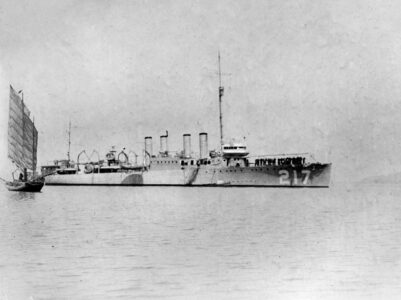
The next ship was also a destroyer, commissioned in 1920. She was 314 feet long, 31 feet wide, and displaced 1308 tons (see photo). The Whipple's first operations were in the regions of the Black Sea and eastern Mediterranean, at one point helping evacuate anti-communist troops from Russia as Bolshevik forces advanced. The years before World War II saw assignments in the Philippines, northern China, the U.S. east coast, Cuba, and Siberia.
At the beginning of hostilities with Japan in 1941, the vulnerable Asiatic fleet was dispersed, sending the Whipple to Southeast Asian ports to fight a "desperate rearguard action." rescuing sailors from mortally damaged aircraft carrier Langley and from the oiler Pecos. For the remainder of the war, U.S.S. Whipple gave service as a convoy escort and submarine hunter, being decommissioned in 1945.
The final namesake honoring Commodore Whipple was a frigate commissioned in 1970 with a primary mission of anti-submarine warfare -- 438 feet long, 47 feet wide, and displacing 4200 tons fully loaded. She gave extensive service during the Vietnam conflict, providing naval gunfire and other support to U.S. and Republic of Vietnam forces. Frigate Whipple was decommissioned in 1992 and transferred to the navy of Mexico in 2005.
Wesley Clarke is a WCHS member. To learn more about the Washington County Historical Society services and membership call 740-373-1788 or visit wchshistory.org.